Page 1 of 1
4. A risk neutral, perfectly discriminating monopolist principal hires an agent to perform a certain task. The agent can
Posted: Mon May 09, 2022 12:34 pm
by answerhappygod
- 4 A Risk Neutral Perfectly Discriminating Monopolist Principal Hires An Agent To Perform A Certain Task The Agent Can 1 (83.7 KiB) Viewed 20 times
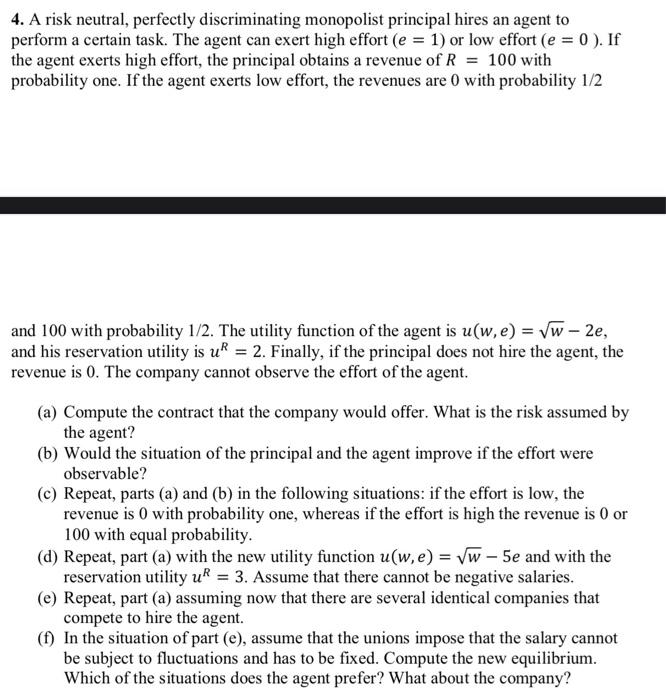
4. A risk neutral, perfectly discriminating monopolist principal hires an agent to perform a certain task. The agent can exert high effort (e = 1) or low effort (e = 0 ). If the agent exerts high effort, the principal obtains a revenue of R = 100 with probability one. If the agent exerts low effort, the revenues are 0 with probability 1/2 and 100 with probability 1/2. The utility function of the agent is u(w,e) = Vw – 2e, and his reservation utility is up = 2. Finally, if the principal does not hire the agent, the revenue is 0. The company cannot observe the effort of the agent. (a) Compute the contract that the company would offer. What is the risk assumed by the agent? (b) Would the situation of the principal and the agent improve if the effort were observable? (c) Repeat, parts (a) and (b) in the following situations: if the effort is low, the revenue is 0 with probability one, whereas if the effort is high the revenue is 0 or 100 with equal probability. (d) Repeat, part (a) with the new utility function u(w, e) = vw – 5e and with the reservation utility up = 3. Assume that there cannot be negative salaries. (e) Repeat, part (a) assuming now that there are several identical companies that compete to hire the agent. (1) In the situation of part (e), assume that the unions impose that the salary cannot be subject to fluctuations and has to be fixed. Compute the new equilibrium. Which of the situations does the agent prefer? What about the company?