Page 1 of 1
Consider a test that measures the level X of a chemical in the blood of a patient to decide whether a disease is present
Posted: Mon May 09, 2022 12:09 pm
by answerhappygod
- Consider A Test That Measures The Level X Of A Chemical In The Blood Of A Patient To Decide Whether A Disease Is Present 1 (126.36 KiB) Viewed 21 times
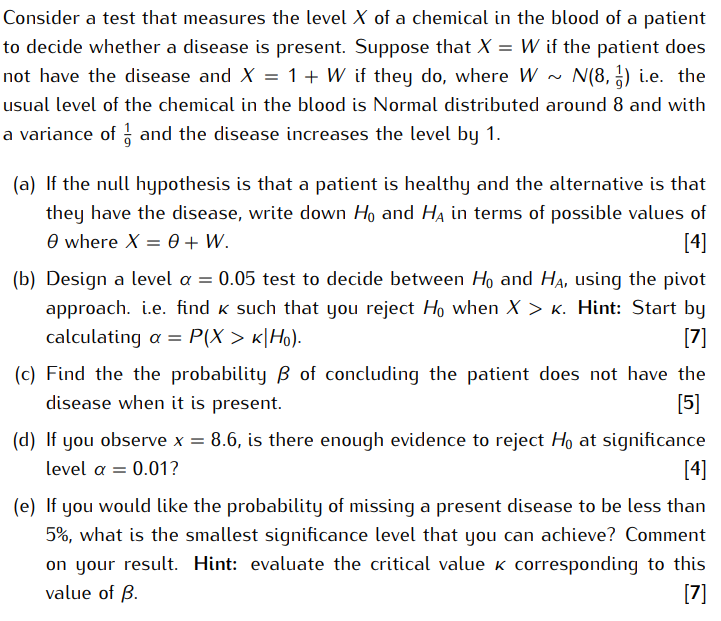
Consider a test that measures the level X of a chemical in the blood of a patient to decide whether a disease is present. Suppose that X = W if the patient does not have the disease and X = 1 + W if they do, where W ~ N(8,) i.e. the usual level of the chemical in the blood is Normal distributed around 8 and with a variance of ; and the disease increases the level by 1. = (a) If the null hypothesis is that a patient is healthy and the alternative is that they have the disease, write down Ho and HA in terms of possible values of where X = 0 + W. [4] (b) Design a level a = 0.05 test to decide between Ho and Ha, using the pivot approach. i.e. find K such that you reject Ho when X > K. Hint: Start by calculating a = P(X> K|Ho). ) [7] (c) Find the the probability B of concluding the patient does not have the disease when it is present. [5] (d) If you observe x = 8.6, is there enough evidence to reject Ho at significance level a = 0.01? [4] (e) If you would like the probability of missing a present disease to be less than 5%, what is the smallest significance level that you can achieve? Comment on your result. Hint: evaluate the critical value k corresponding to this value of B. [7]