Page 1 of 1
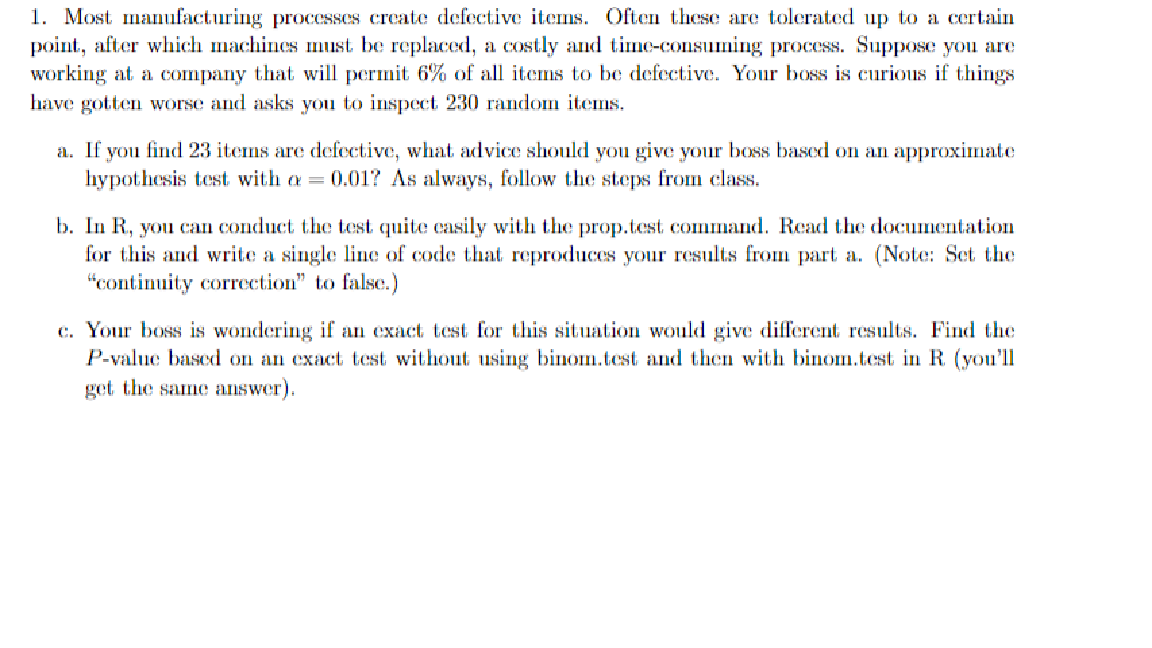
1. Most manufacturing processes create defective items. Often these are tolerated up to a certain point, after which mac
Posted: Mon May 09, 2022 12:05 pm
by answerhappygod
- 1 Most Manufacturing Processes Create Defective Items Often These Are Tolerated Up To A Certain Point After Which Mac 1 (113.72 KiB) Viewed 20 times
1. Most manufacturing processes create defective items. Often these are tolerated up to a certain point, after which machines must be replaced, a costly and time-consuming process. Suppose you are working at a company that will permit 6% of all items to be defective. Your boss is curious if things have gotten worse and asks you to inspect 230 random items. a. If you find 23 items are defective, what advice should you give your boss based on an approximate hypothesis test with a = 0.01? As always, follow the steps from class. b. In R, you can conduct the test quite easily with the prop.test command. Read the documentation for this and write a single line of code that reproduces your results from part a. (Note: Set the "continuity correction" to false.) c. Your boss is wondering if an exact test for this situation would give different results. Find the P-value based on an exact test without using binom.test and then with binom.test in R (you'll get the same answer).