Page 1 of 1
Theorem 2: If A is symmetric, then any two eigenvectors from different eigenspaces (i.e. corresponding to different eige
Posted: Mon May 09, 2022 11:10 am
by answerhappygod
- Theorem 2 If A Is Symmetric Then Any Two Eigenvectors From Different Eigenspaces I E Corresponding To Different Eige 1 (89.45 KiB) Viewed 32 times
- Theorem 2 If A Is Symmetric Then Any Two Eigenvectors From Different Eigenspaces I E Corresponding To Different Eige 2 (33.15 KiB) Viewed 32 times
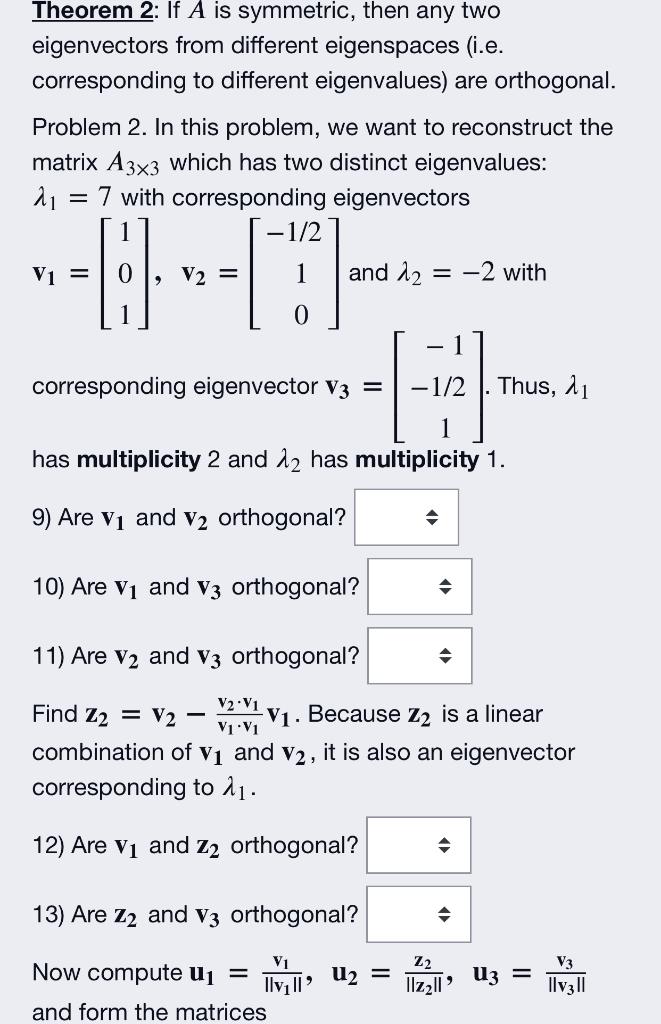
Theorem 2: If A is symmetric, then any two eigenvectors from different eigenspaces (i.e. corresponding to different eigenvalues) are orthogonal. Problem 2. In this problem, we want to reconstruct the matrix A3x3 which has two distinct eigenvalues: 21 = 7 with corresponding eigenvectors -1/2 V1 = 0 V2 = 1 and 12 = -2 with 0 corresponding eigenvector V3 = -1/2 Thus, has multiplicity 2 and 12 has multiplicity 1. 9) Are V1 and v2 orthogonal? 10) Are V1 and V3 orthogonal? . 11) Are V2 and V3 orthogonal? Find Z2 = V2 V2.VI V1. Because Z2 is a linear combination of V1 and v2, it is also an eigenvector corresponding to 11. 12) Are V1 and 22 orthogonal? 13) Are Z2 and V3 orthogonal? V1 Z2 Now compute U1 = Ily,ll> նշ = Ilzell || U3 = V3 Ilv3|| and form the matrices
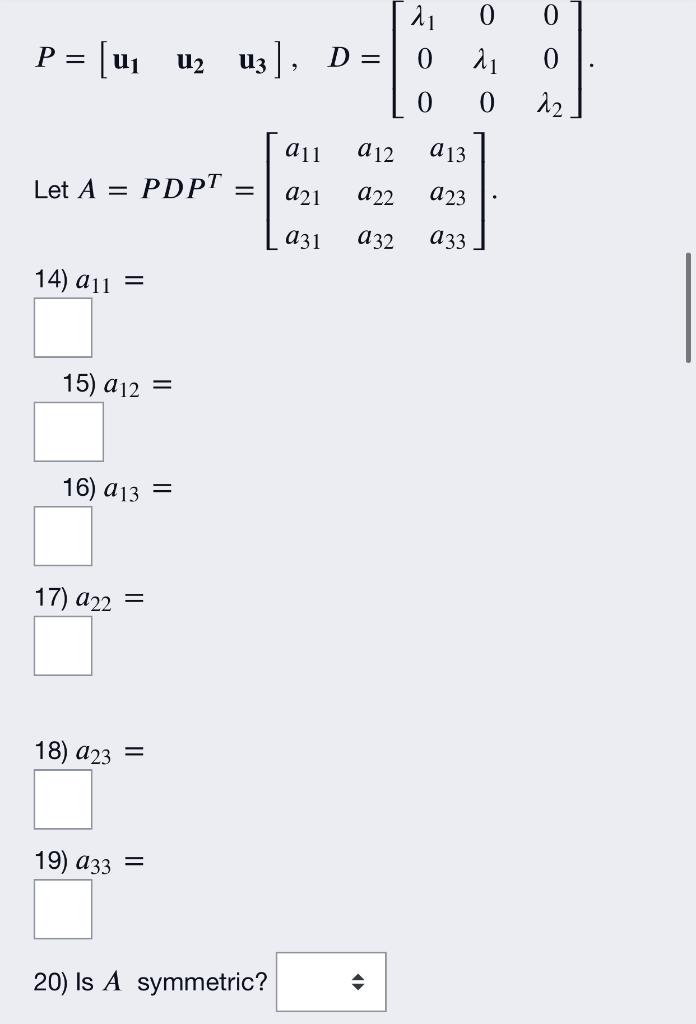
0 0 P = [ui u2 a 0 = uz], D= 21 0 0 0 12 011 012 013 Let A = PDPT == 021 022 023 031 a32 033 14) a11 = 15) (12 = 16) 13 = 17) a22 = 18) 023 = 19) 433 = 20) Is A symmetric?