- 3 In This Question You Are Given A Result With An Outline Of The Proof And Are Asked To Fill In The Details Answer T 1 (114.64 KiB) Viewed 31 times
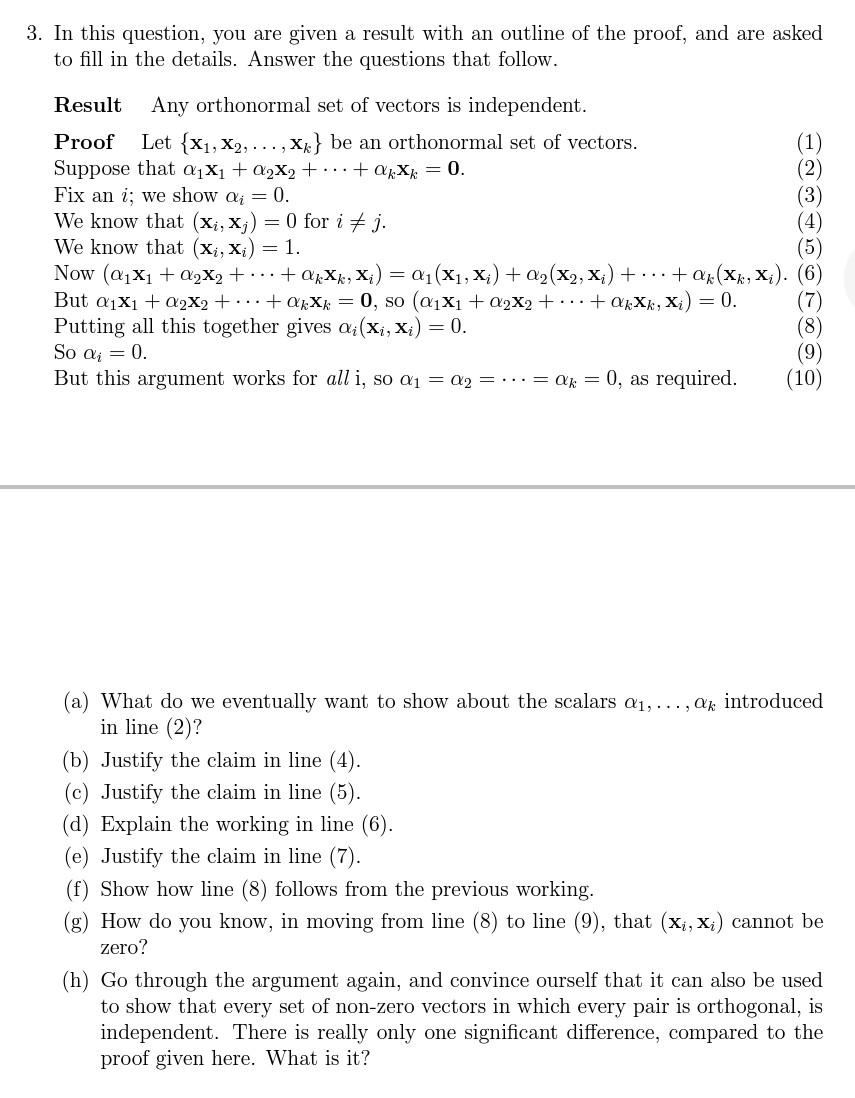
3. In this question, you are given a result with an outline of the proof, and are asked to fill in the details. Answer the questions that follow. Result Any orthonormal set of vectors is independent. Proof Let {X1, X2, ..., Xx} be an orthonormal set of vectors. Suppose that Q1X1 + a2X2 + ... + 2xXx = 0. Fix an i; we show ai = 0. We know that (Xi, x;) = 0 for i + j. We know that (Xi, xi) = 1. Now (Q1X1 + a2X2 + ... + QxXk, Xi) = 01(X1, X;) + Q2(X2, xi) + ... + ax(Xk, X;). (6) But a 1X1 + a2X2 + ... + akXk = 0, so (@1X1 + a2X2 + ... + QkXk, X;) = 0. Putting all this together gives aj(Xi, Xi) = 0. So a = 0. But this argument works for all i, so a1 = 02 = ... = ax = 0, as required. (10 SOCI@GEONE (a) What do we eventually want to show about the scalars Q1,..., ak introduced in line (2)? (b) Justify the claim in line (4). (c) Justify the claim in line (5). (d) Explain the working in line 6). (e) Justify the claim in line (7). (f) Show how line (8) follows from the previous working. (g) How do you know, in moving from line (8) to line (9), that (Xị, xi) cannot be zero? (h) Go through the argument again, and convince ourself that it can also be used to show that every set of non-zero vectors in which every pair is orthogonal, is independent. There is really only one significant difference, compared to the proof given here. What is it?