Page 1 of 1
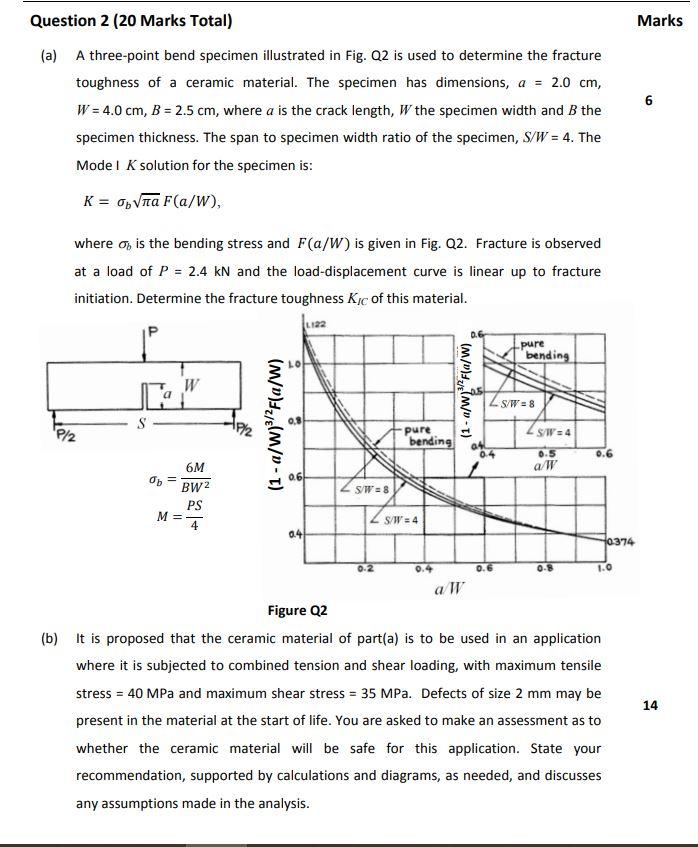
Marks LO Question 2 (20 Marks Total) (a) A three-point bend specimen illustrated in Fig. Q2 is used to determine the fra
Posted: Mon May 09, 2022 10:01 am
by answerhappygod
- Marks Lo Question 2 20 Marks Total A A Three Point Bend Specimen Illustrated In Fig Q2 Is Used To Determine The Fra 1 (93.13 KiB) Viewed 34 times
Marks LO Question 2 (20 Marks Total) (a) A three-point bend specimen illustrated in Fig. Q2 is used to determine the fracture toughness of a ceramic material. The specimen has dimensions, a = 2.0 cm, W = 4.0 cm, B = 2.5 cm, where a is the crack length, W the specimen width and B the specimen thickness. The span to specimen width ratio of the specimen, S/W = 4. The Model K solution for the specimen is: K = Obvia F(a/W), where on is the bending stress and F(a/W) is given in Fig. 22. Fracture is observed at a load of P = 2.4 kN and the load-displacement curve is linear up to fracture initiation. Determine the fracture toughness Kic of this material. pure bending W a Zsw=8 (M/":/TM/-T) (1 - a/w)Fla/W) 2/2 pure SW=4 bending 08 0.6 0.5 a/W ob 0.6| 6M BW2 PS Z s/w = 8 M= 4 S/W=4 0.4 0374 0.2 0.4 0.6 1. 1.0 a W Figure Q2 (b) It is proposed that the ceramic material of part(a) is to be used in an application where it is subjected to combined tension and shear loading, with maximum tensile stress = 40 MPa and maximum shear stress = 35 MPa. Defects of size 2 mm may be present in the material at the start of life. You are asked to make an assessment as to whether the ceramic material will be safe for this application. State your recommendation, supported by calculations and diagrams, as needed, and discusses any assumptions made in the analysis. 14