Page 1 of 1
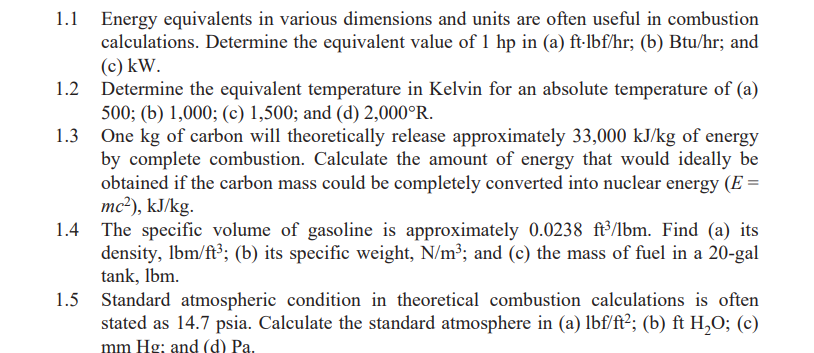
1.1 Energy equivalents in various dimensions and units are often useful in combustion calculations. Determine the equiva
Posted: Mon May 09, 2022 9:32 am
by answerhappygod
- 1 1 Energy Equivalents In Various Dimensions And Units Are Often Useful In Combustion Calculations Determine The Equiva 1 (108.46 KiB) Viewed 28 times
1.1 Energy equivalents in various dimensions and units are often useful in combustion calculations. Determine the equivalent value of 1 hp in (a) ft·lbf/hr; (b) Btu/hr; and (c) kW. 1.2 Determine the equivalent temperature in Kelvin for an absolute temperature of (a) 500; (b) 1,000; (c) 1,500; and (d) 2,000°R. 1.3 One kg of carbon will theoretically release approximately 33,000 kJ/kg of energy by complete combustion. Calculate the amount of energy that would ideally be obtained if the carbon mass could be completely converted into nuclear energy (E = mc), kJ/kg. The specific volume of gasoline is approximately 0.0238 ft3/lbm. Find (a) its density, lbm/ft?; (b) its specific weight, N/m?; and (c) the mass of fuel in a 20-gal tank, lbm. 1.5 Standard atmospheric condition in theoretical combustion calculations is often stated as 14.7 psia. Calculate the standard atmosphere in (a) lbf/ft?; (b) ft H20; (c) mm Hg: and (d) Pa.