Page 1 of 1
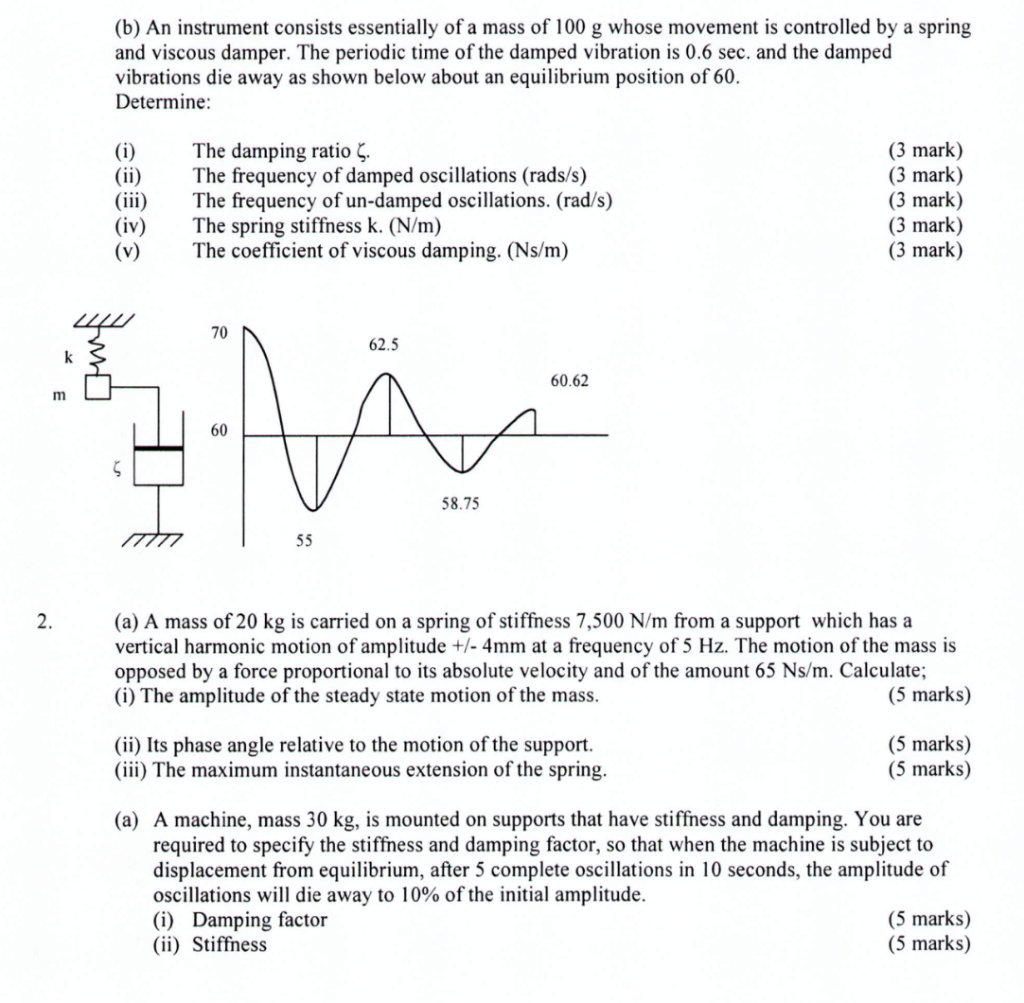
(b) An instrument consists essentially of a mass of 100 g whose movement is controlled by a spring and viscous damper. T
Posted: Mon May 09, 2022 9:23 am
by answerhappygod
- B An Instrument Consists Essentially Of A Mass Of 100 G Whose Movement Is Controlled By A Spring And Viscous Damper T 1 (849.92 KiB) Viewed 19 times
(b) An instrument consists essentially of a mass of 100 g whose movement is controlled by a spring and viscous damper. The periodic time of the damped vibration is 0.6 sec. and the damped vibrations die away as shown below about an equilibrium position of 60. Determine: (i) (ii) (iii) (iv) (v) The damping ratio Ę. The frequency of damped oscillations (rads/s) The frequency of un-damped oscillations. (rad/s) The spring stiffness k. (N/m) The coefficient of viscous damping. (Ns/m) (3 mark) (3 mark) (3 mark) (3 mark) (3 mark) 4 70 62.5 k tud 60.62 m 60 5 58.75 55 2. . (a) A mass of 20 kg is carried on a spring of stiffness 7,500 N/m from a support which has a vertical harmonic motion of amplitude +/- 4mm at a frequency of 5 Hz. The motion of the mass is opposed by a force proportional to its absolute velocity and of the amount 65 Ns/m. Calculate; (i) The amplitude of the steady state motion of the mass. (5 marks) (ii) Its phase angle relative to the motion of the support. (iii) The maximum instantaneous extension of the spring. (5 marks) (5 marks) (a) A machine, mass 30 kg, is mounted on supports that have stiffness and damping. You are required to specify the stiffness and damping factor, so that when the machine is subject to displacement from equilibrium, after 5 complete oscillations in 10 seconds, the amplitude of oscillations will die away to 10% of the initial amplitude. (i) Damping factor (5 marks) (ii) Stiffness (5 marks)