Page 1 of 1
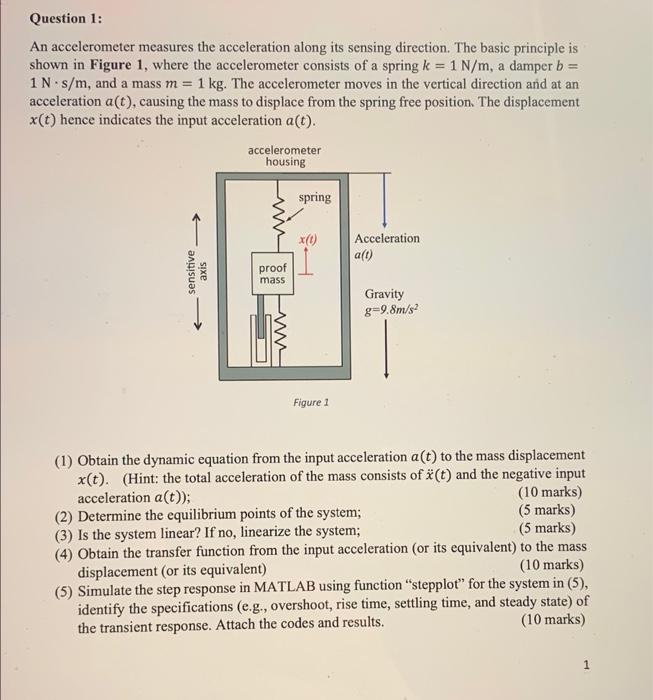
Question 1: An accelerometer measures the acceleration along its sensing direction. The basic principle is shown in Figu
Posted: Mon May 09, 2022 9:16 am
by answerhappygod
- Question 1 An Accelerometer Measures The Acceleration Along Its Sensing Direction The Basic Principle Is Shown In Figu 1 (58.4 KiB) Viewed 21 times
Question 1: An accelerometer measures the acceleration along its sensing direction. The basic principle is shown in Figure 1, where the accelerometer consists of a spring k = 1 N/m, a damper b = 1 N s/m, and a mass m = 1 kg. The accelerometer moves in the vertical direction and at an acceleration a(t), causing the mass to displace from the spring free position. The displacement x() hence indicates the input acceleration a(). accelerometer housing spring x(0) Acceleration a(1) sensitive sixe proof mass Gravity g=9.8m/s2 w Figure 1 (1) Obtain the dynamic equation from the input acceleration a(t) to the mass displacement x(t). (Hint: the total acceleration of the mass consists of X(t) and the negative input acceleration a(t)); (10 marks) (2) Determine the equilibrium points of the system; (5 marks) (3) Is the system linear? If no, linearize the system; (5 marks) (4) Obtain the transfer function from the input acceleration (or its equivalent) to the mass displacement (or its equivalent) (10 marks) (5) Simulate the step response in MATLAB using function "stepplot" for the system in (5), identify the specifications (e.g., overshoot, rise time, settling time, and steady state) of the transient response. Attach the codes and results. (10 marks) 1