Page 1 of 1
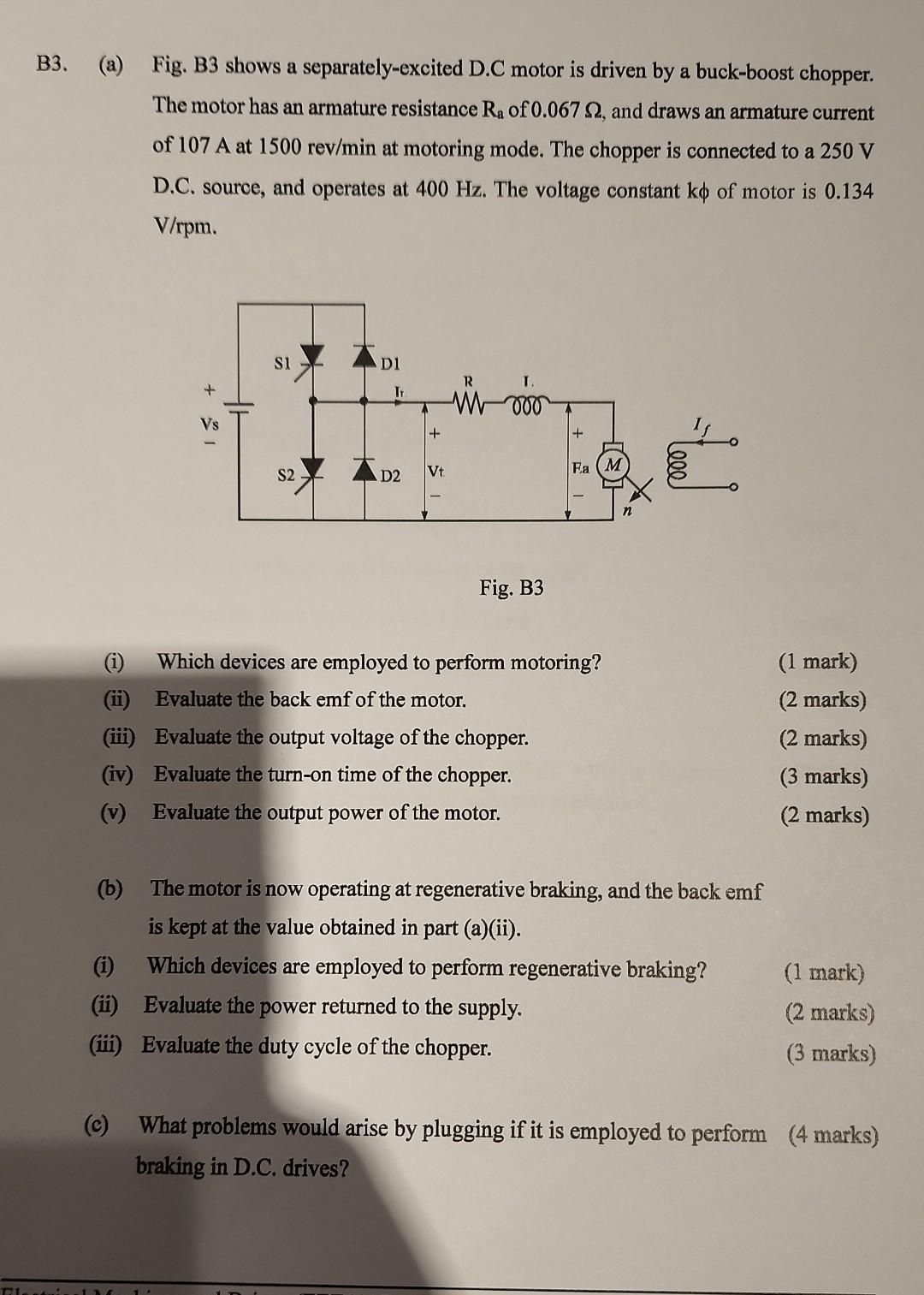
B3. (a) Fig. B3 shows a separately-excited D.C motor is driven by a buck-boost chopper. The motor has an armature resist
Posted: Mon May 09, 2022 8:10 am
by answerhappygod
- B3 A Fig B3 Shows A Separately Excited D C Motor Is Driven By A Buck Boost Chopper The Motor Has An Armature Resist 1 (146.88 KiB) Viewed 21 times
B3. (a) Fig. B3 shows a separately-excited D.C motor is driven by a buck-boost chopper. The motor has an armature resistance Ra of 0.067 Q2, and draws an armature current of 107 A at 1500 rev/min at motoring mode. The chopper is connected to a 250 V D.C. source, and operates at 400 Hz. The voltage constant ko of motor is 0.134 V/rpm. SI D1 T. + 000 Vs + + S2 Fa (M D2 Vt Fig. B3 Which devices are employed to perform motoring? (ü) Evaluate the back emf of the motor. (iii) Evaluate the output voltage of the chopper. (iv) Evaluate the turn-on time of the chopper. (v) Evaluate the output power of the motor. (1 mark) (2 marks) (2 marks) (3 marks) (2 marks) (b) The motor is now operating at regenerative braking, and the back emf is kept at the value obtained in part (a)(ii). Which devices are employed to perform regenerative braking? (*) Evaluate the power returned to the supply. (iii) Evaluate the duty cycle of the chopper. (1 mark) (2 marks) (3 marks) (©) What problems would arise by plugging if it is employed to perform (4 marks) braking in D.C. drives? 11