Page 1 of 1
Problem 1 w Electric utilities do not normally try to exert any control over the amount of power that their customers dr
Posted: Mon May 09, 2022 8:08 am
by answerhappygod
- Problem 1 W Electric Utilities Do Not Normally Try To Exert Any Control Over The Amount Of Power That Their Customers Dr 1 (43.5 KiB) Viewed 21 times
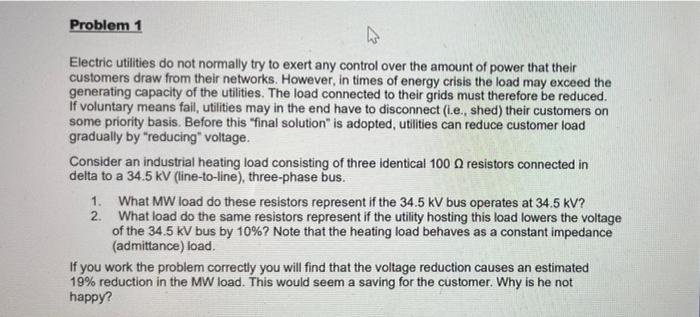
Problem 1 w Electric utilities do not normally try to exert any control over the amount of power that their customers draw from their networks. However, in times of energy crisis the load may exceed the generating capacity of the utilities. The load connected to their grids must therefore be reduced. If voluntary means fail, utilities may in the end have to disconnect (i.e.,shed) their customers on some priority basis. Before this "final solution" is adopted, utilities can reduce customer load gradually by "reducing" voltage. Consider an industrial heating load consisting of three identical 100 resistors connected in delta to a 34.5 kV (line-to-line), three-phase bus. 1. What MW load do these resistors represent if the 34.5 kV bus operates at 34.5 kV? 2. What load do the same resistors represent if the utility hosting this load lowers the voltage of the 34.5 kV bus by 10%? Note that the heating load behaves as a constant impedance (admittance) load. If you work the problem correctly you will find that the voltage reduction causes an estimated 19% reduction in the MW load. This would seem a saving for the customer. Why is he not happy?