Page 1 of 1
I. An initial class Rational for fractions like, e.g. 4/5, is defined as follows. the following questions should modify
Posted: Mon May 09, 2022 6:26 am
by answerhappygod
- I An Initial Class Rational For Fractions Like E G 4 5 Is Defined As Follows The Following Questions Should Modify 1 (198.95 KiB) Viewed 31 times
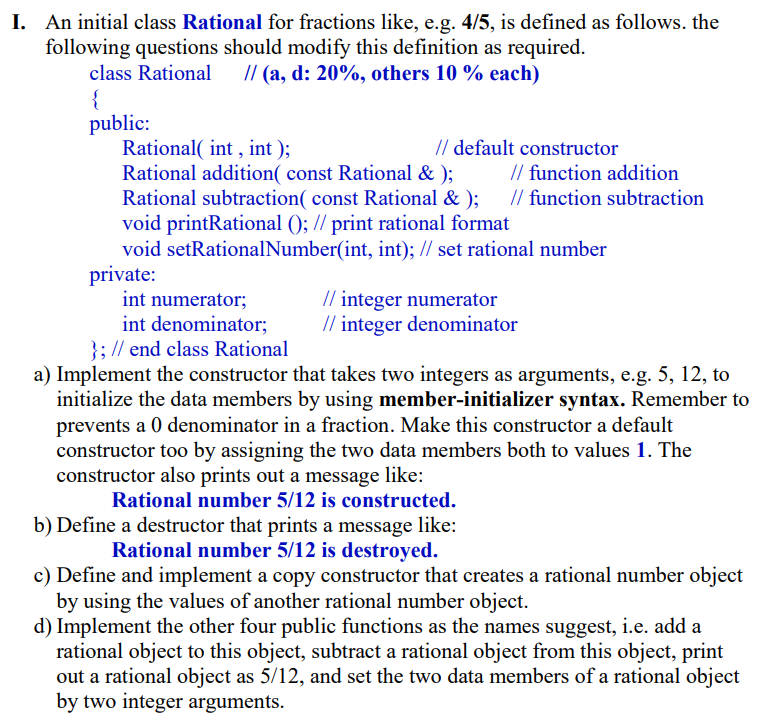
I. An initial class Rational for fractions like, e.g. 4/5, is defined as follows. the following questions should modify this definition as required. class Rational II (a, d: 20%, others 10 % each) { public: Rational( int , int ); // default constructor Rational addition( const Rational & ); // function addition Rational subtraction( const Rational & ); // function subtraction void printRational (); // print rational format void setRationalNumber(int, int); // set rational number private: int numerator; // integer numerator int denominator; // integer denominator }; // end class Rational a) Implement the constructor that takes two integers as arguments, e.g. 5, 12, to initialize the data members by using member-initializer syntax. Remember to prevents a 0 denominator in a fraction. Make this constructor a default constructor too by assigning the two data members both to values 1. The constructor also prints out a message like: Rational number 5/12 is constructed. b) Define a destructor that prints a message like: Rational number 5/12 is destroyed. c) Define and implement a copy constructor that creates a rational number object by using the values of another rational number object. d) Implement the other four public functions as the names suggest, i.e. add a rational object to this object, subtract a rational object from this object, print out a rational object as 5/12, and set the two data members of a rational object by two integer arguments.
e) Overload the addition operator (+) as a member function to add another rational number to this rational number object. Make this overloaded function able to perform cascaded operations like: Ra+Rb+Rc. f) Overload the stream insertion operator << and stream extraction operator >> as global functions to print out a rational number as cout << rationalObject directly and to input a rational number directly as cin >> rationalObject. g) Overload the == and the != operators to allow comparisons of two rational numbers. (please use definition of == to define !=) h) Overload the ++ the -- operators for pre- and post-increment and decrement operations that adds 1 to and minus 1 from a Rational number object.