Page 1 of 1
Suppose that a public good is to be provided to a group of n people if only if at least one person is willing to pay the
Posted: Sun May 08, 2022 10:24 am
by answerhappygod
- Suppose That A Public Good Is To Be Provided To A Group Of N People If Only If At Least One Person Is Willing To Pay The 1 (82.77 KiB) Viewed 40 times
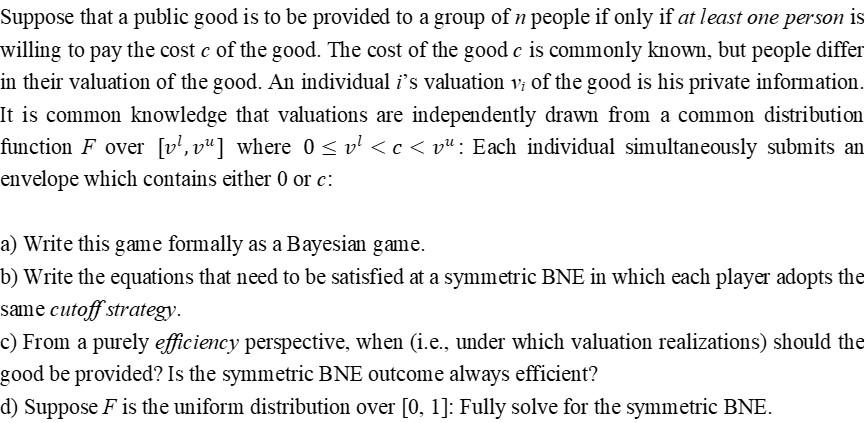
Suppose that a public good is to be provided to a group of n people if only if at least one person is willing to pay the cost c of the good. The cost of the good c is commonly known, but people differ in their valuation of the good. An individual i's valuation v; of the good is his private information. It is common knowledge that valuations are independently drawn from a common distribution function F over [v!, vu] where 0 sv! <c<vu: Each individual simultaneously submits an envelope which contains either 0 or c: a) Write this game formally as a Bayesian game. b) Write the equations that need to be satisfied at a symmetric BNE in which each player adopts the same cutoff strategy. c) From a purely efficiency perspective, when (i.e., under which valuation realizations) should the good be provided? Is the symmetric BNE outcome always efficient? d) Suppose F is the uniform distribution over [0, 1]: Fully solve for the symmetric BNE.