Page 1 of 1
5. Two players are chosen and designated A and B. The experimenter puts a dime on the table. Player A can take it or pas
Posted: Sun May 08, 2022 9:43 am
by answerhappygod
- 5 Two Players Are Chosen And Designated A And B The Experimenter Puts A Dime On The Table Player A Can Take It Or Pas 1 (51.29 KiB) Viewed 33 times
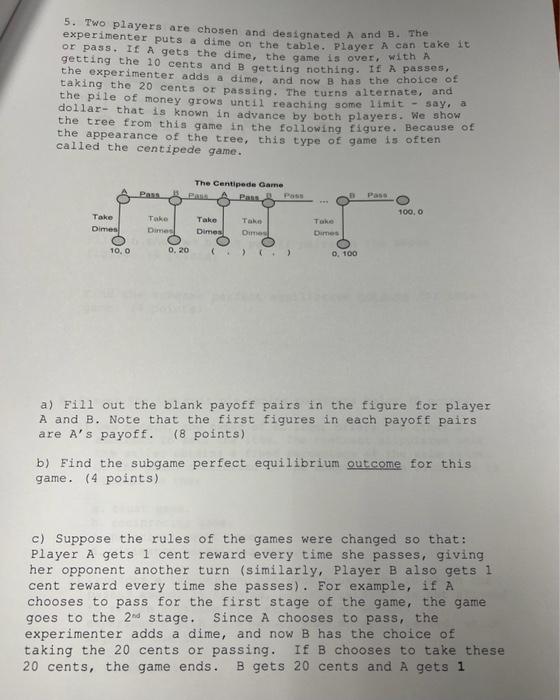
5. Two players are chosen and designated A and B. The experimenter puts a dime on the table. Player A can take it or pass. If A gets the dime, the game is over, with a getting the 10 cents and B getting nothing. If A passes, the experimenter adds a dime, and now B has the choice of taking the 20 cents or passing. The turns alternate, and the pile of money grows until reaching some limit - say, a dollar- that is known in advance by both players. We show the tree from this game in the following figure. Because of the appearance of the tree, this type of game is often called the centipede game. The Centipede Game Rann Pass 100,0 Take Take Dimes Take Dimes Dimes Toe Dimes Take Dimes 10,0 0. 20 0.100 a) Fill out the blank payoff pairs in the figure for player A and B. Note that the first figures in each payoff pairs are A's payoff. (8 points) b) Find the subgame perfect equilibrium outcome for this game. (4 points) c) Suppose the rules of the games were changed so that: Player A gets 1 cent reward every time she passes, giving her opponent another turn (similarly, Player B also gets 1 cent reward every time she passes). For example, if A chooses to pass for the first stage of the game, the game goes to the 2 stage. Since A chooses to pass, the experimenter adds a dime, and now B has the choice of taking the 20 cents or passing. If B chooses to take these 20 cents, the game ends. B gets 20 cents and A gets 1