Page 1 of 1
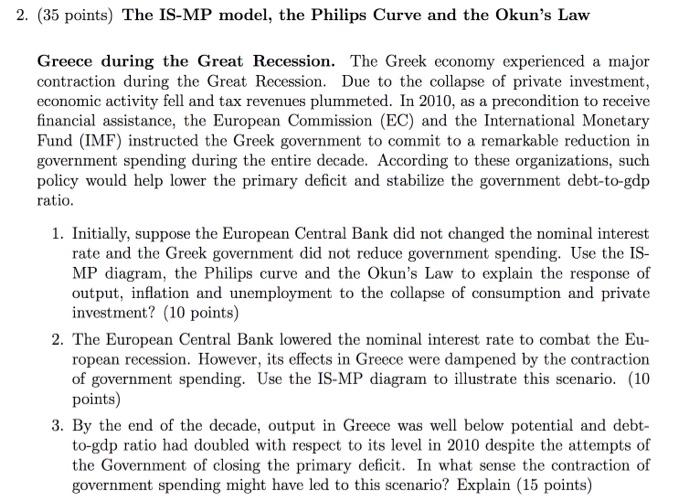
2. (35 points) The IS-MP model, the Philips Curve and the Okun's Law Greece during the Great Recession. The Greek econom
Posted: Sun May 08, 2022 9:40 am
by answerhappygod
- 2 35 Points The Is Mp Model The Philips Curve And The Okun S Law Greece During The Great Recession The Greek Econom 1 (85.49 KiB) Viewed 34 times
2. (35 points) The IS-MP model, the Philips Curve and the Okun's Law Greece during the Great Recession. The Greek economy experienced a major contraction during the Great Recession. Due to the collapse of private investment, economic activity fell and tax revenues plummeted. In 2010, as a precondition to receive financial assistance, the European Commission (EC) and the International Monetary Fund (IMF) instructed the Greek government to commit to a remarkable reduction in government spending during the entire decade. According to these organizations, such policy would help lower the primary deficit and stabilize the government debt-to-gdp ratio. 1. Initially, suppose the European Central Bank did not changed the nominal interest rate and the Greek government did not reduce government spending. Use the IS- MP diagram, the Philips curve and the Okun's Law to explain the response of output, inflation and unemployment to the collapse of consumption and private investment? (10 points) 2. The European Central Bank lowered the nominal interest rate to combat the Eu- ropean recession. However, its effects in Greece were dampened by the contraction of government spending. Use the IS-MP diagram to illustrate this scenario. (10 points) 3. By the end of the decade, output in Greece was well below potential and debt- to-gdp ratio had doubled with respect to its level in 2010 despite the attempts of the Government of closing the primary deficit. In what sense the contraction of government spending might have led to this scenario? Explain (15 points)