- 1 C A State Is Planing The Construction Of A New Bridge Across A River If Built This Bridge Would Reduce Travel Time 1 (112.73 KiB) Viewed 27 times
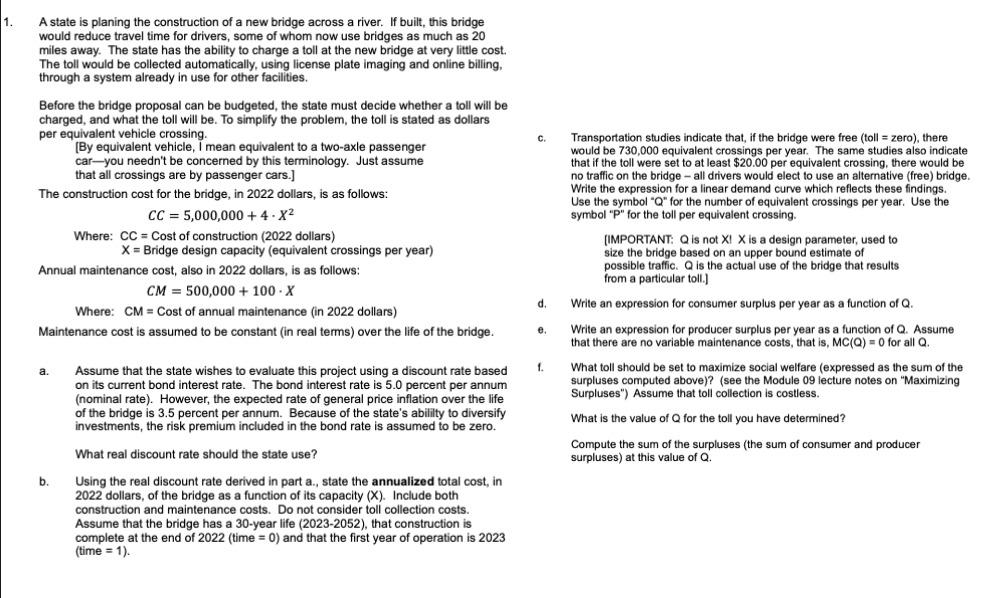
1. c. A state is planing the construction of a new bridge across a river. If built, this bridge would reduce travel time for drivers, some of whom now use bridges as much as 20 miles away. The state has the ability to charge a toll at the new bridge at very little cost. The toll would be collected automatically, using license plate imaging and online billing, through a system already in use for other facilities. Before the bridge proposal can be budgeted, the state must decide whether a toll will be charged, and what the toll will be. To simplify the problem, the toll is stated as dollars per equivalent vehicle crossing. (By equivalent vehicle, I mean equivalent to a two-axle passenger car-you needn't be concerned by this terminology. Just assume that all crossings are by passenger cars.] The construction cost for the bridge, in 2022 dollars, is as follows: CC = 5,000,000+ 4.X2 Where: CC = Cost of construction (2022 dollars) X = Bridge design capacity (equivalent crossings per year) Annual maintenance cost, also in 2022 dollars, is as follows: CM = 500,000 + 100-X Where: CM = Cost of annual maintenance (in 2022 dollars) Maintenance cost is assumed to be constant (in real terms) over the life of the bridge. Transportation studies indicate that, if the bridge were free toll = zero), there would be 730,000 equivalent crossings per year. The same studies also indicate that if the toll were set to at least $20.00 per equivalent crossing, there would be no traffic on the bridge - all drivers would elect to use an alternative (free) bridge. Write the expression for a linear demand curve which reflects these findings. Use the symbol "Q" for the number of equivalent crossings per year. Use the symbol "P" for the toll per equivalent crossing. (IMPORTANT: Q is not XI X is a design parameter, used to size the bridge based on an upper bound estimate of possible traffic. Q is the actual use of the bridge that results from a particular toll.] d Write an expression for consumer surplus per year as a function of Q. Write an expression for producer surplus per year as a function of Q. Assume that there are no variable maintenance costs, that is, MC(Q)=0 for all Q. e 1. a. Assume that the state wishes to evaluate this project using a discount rate based on its current bond interest rate. The bond interest rate is 5.0 percent per annum (nominal rate). However, the expected rate of general price inflation over the life of the bridge is 3.5 percent per annum. Because of the state's ability to diversify investments, the risk premium included in the bond rate is assumed to be zero. What toll should be set to maximize social welfare (expressed as the sum of the surpluses computed above)? (see the Module 09 lecture notes on "Maximizing Surpluses") Assume that toll collection is costless. What is the value of Q for the toll you have determined? What real discount rate should the state use? Compute the sum of the surpluses (the sum of consumer and producer surpluses) at this value of Q. b. Using the real discount rate derived in part a., state the annualized total cost, in 2022 dollars, of the bridge as a function of its capacity (X). Include both construction and maintenance costs. Do not consider toll collection costs. Assume that the bridge has a 30-year life (2023-2052), that construction is complete at the end of 2022 (time = 0) and that the first year of operation is 2023 (time = 1).