Page 1 of 1
B.II.2 An optimising consumer has total budget y and consumes two goods, cheese qi and bread 92, purchased at the prices
Posted: Sun May 08, 2022 9:14 am
by answerhappygod
- B Ii 2 An Optimising Consumer Has Total Budget Y And Consumes Two Goods Cheese Qi And Bread 92 Purchased At The Prices 1 (493.42 KiB) Viewed 31 times
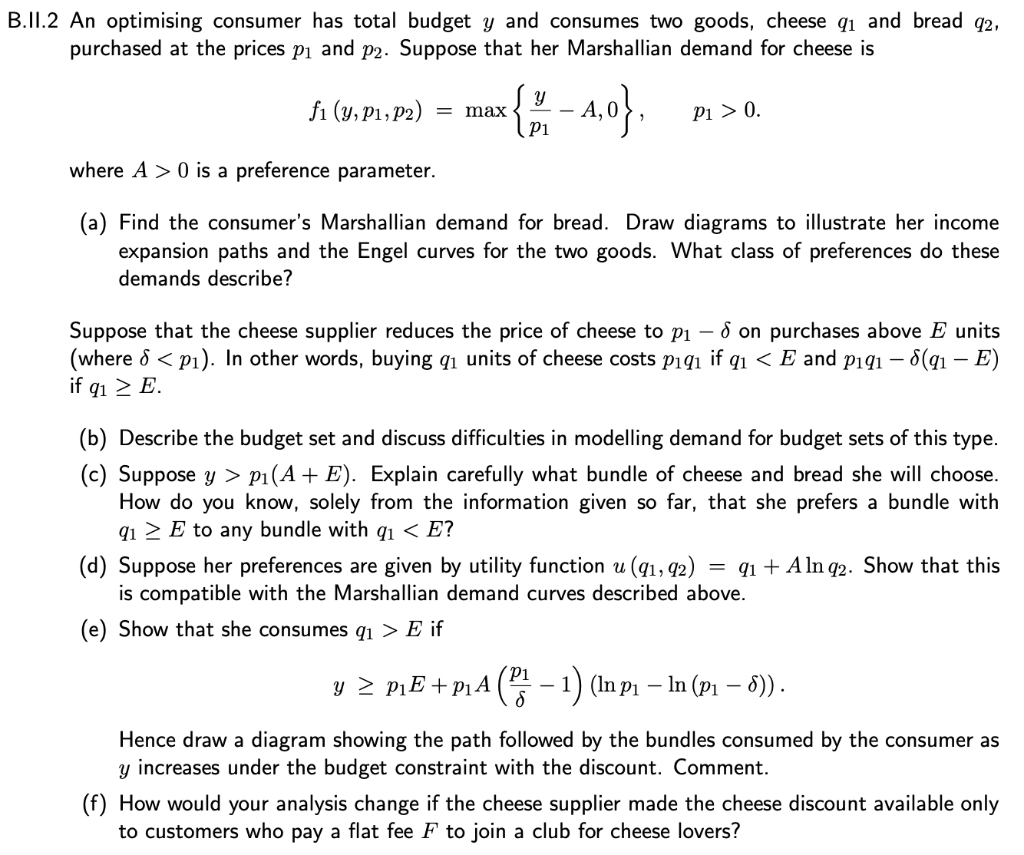
B.II.2 An optimising consumer has total budget y and consumes two goods, cheese qi and bread 92, purchased at the prices pı and p2. Suppose that her Marshallian demand for cheese is fi (y, P1, P2) max {": -1,0}, Pi > 0. Pi where A > 0 is a preference parameter. (a) Find the consumer's Marshallian demand for bread. Draw diagrams to illustrate her income expansion paths and the Engel curves for the two goods. What class of preferences do these demands describe? Suppose that the cheese supplier reduces the price of cheese to p1 - 8 on purchases above E units (where 8 <pı). In other words, buying q1 units of cheese costs piqı if q1 < E and p1q1 – (21 – E) if qı > E - (b) Describe the budget set and discuss difficulties in modelling demand for budget sets of this type. (c) Suppose y > pi(A + E). Explain carefully what bundle of cheese and bread she will choose. How do you know, solely from the information given so far, that she prefers a bundle with 91 > E to any bundle with qı < E? (d) Suppose her preferences are given by utility function u (qı, q2) = 91 + A ln q2. Show that this is compatible with the Marshallian demand curves described above. (e) Show that she consumes q1 > E if y 2 PLE+p1A (906 - 1) (In pı – In (p1 – 8). - Hence draw a diagram showing the path followed by the bundles consumed by the consumer as y increases under the budget constraint with the discount. Comment. (f) How would your analysis change if the cheese supplier made the cheese discount available only to customers who pay a flat fee F to join a club for cheese lovers?