Page 1 of 1
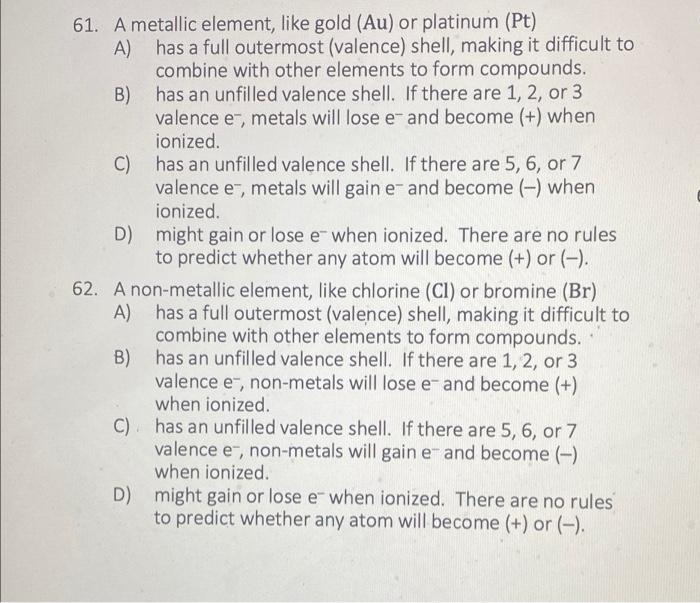
61. A metallic element, like gold (Au) or platinum (Pt) A) B) has a full outermost (valence) shell, making it difficult
Posted: Fri May 06, 2022 1:08 pm
by answerhappygod
- 61 A Metallic Element Like Gold Au Or Platinum Pt A B Has A Full Outermost Valence Shell Making It Difficult 1 (72.68 KiB) Viewed 41 times
61. A metallic element, like gold (Au) or platinum (Pt) A) B) has a full outermost (valence) shell, making it difficult to combine with other elements to form compounds. has an unfilled valence shell. If there are 1, 2, or 3 valence e, metals will lose e and become (+) when ionized. C) has an unfilled valence shell. If there are 5, 6, or 7 valence e, metals will gain e- and become (-) when ionized. D) might gain or lose e when ionized. There are no rules to predict whether any atom will become (+) or (-). 62. A non-metallic element, like chlorine (CI) or bromine (Br) has a full outermost (valence) shell, making it difficult to combine with other elements to form compounds. has an unfilled valence shell. If there are 1, 2, or 3 valence e, non-metals will lose e- and become (+) when ionized. A) B) C) has an unfilled valence shell. If there are 5, 6, or 7 valence e, non-metals will gain e- and become (-) when ionized. D) might gain or lose e when ionized. There are no rules to predict whether any atom will become (+) or (-).