Page 1 of 1
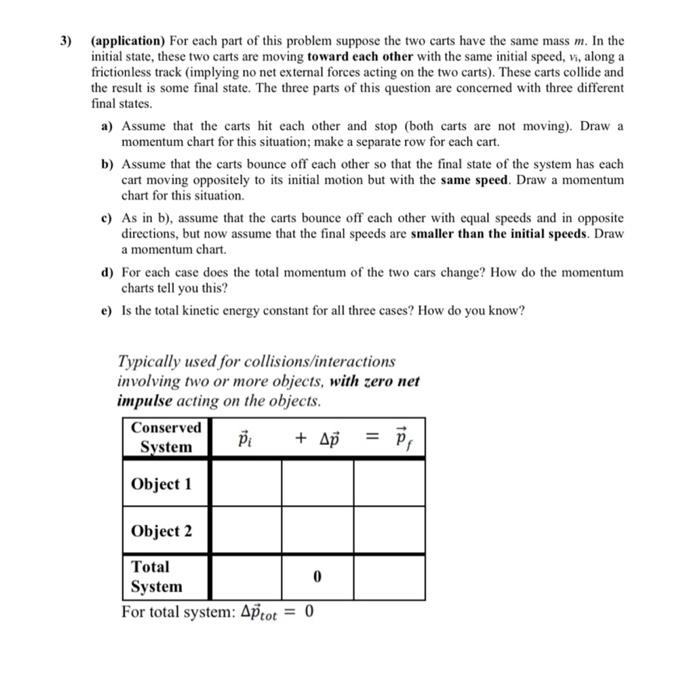
3) (application) For each part of this problem suppose the two carts have the same mass m. In the initial state, these t
Posted: Fri May 06, 2022 11:55 am
by answerhappygod
- 3 Application For Each Part Of This Problem Suppose The Two Carts Have The Same Mass M In The Initial State These T 1 (59.22 KiB) Viewed 23 times
3) (application) For each part of this problem suppose the two carts have the same mass m. In the initial state, these two carts are moving toward each other with the same initial speed, vi, along a frictionless track (implying no net external forces acting on the two carts). These carts collide and the result is some final state. The three parts of this question are concerned with three different final states. a) Assume that the carts hit each other and stop (both carts are not moving). Draw a momentum chart for this situation; make a separate row for each cart. b) Assume that the carts bounce off each other so that the final state of the system has each cart moving oppositely to its initial motion but with the same speed. Draw a momentum chart for this situation. c) As in b), assume that the carts bounce off each other with equal speeds and in opposite directions, but now assume that the final speeds are smaller than the initial speeds. Draw a momentum chart. d) For each case does the total momentum of the two cars change? How do the momentum charts tell you this? e) Is the total kinetic energy constant for all three cases? How do you know? Typically used for collisions/interactions involving two or more objects, with zero net impulse acting on the objects. Conserved Pi + Ap = P₁ System Object 1 Object 2 Total 0 System For total system: Aptot = 0