Page 1 of 1
In a previous activity, you were presented with the following exercise: A ball is thrown into the air with a speed of 2.
Posted: Fri May 06, 2022 10:09 am
by answerhappygod
- In A Previous Activity You Were Presented With The Following Exercise A Ball Is Thrown Into The Air With A Speed Of 2 1 (40.96 KiB) Viewed 33 times
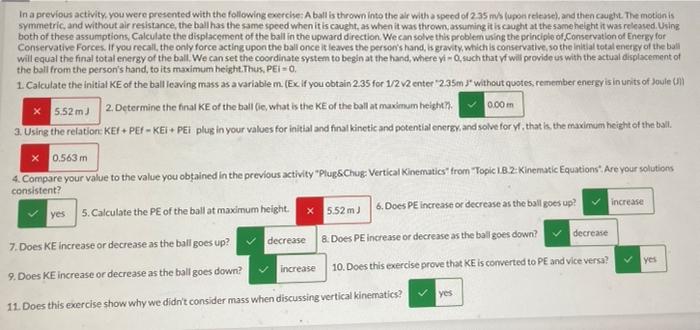
In a previous activity, you were presented with the following exercise: A ball is thrown into the air with a speed of 2.35 m/s (upon release), and then caught. The motion is symmetric, and without air resistance, the ball has the same speed when it is caught, as when it was thrown, assuming it is caught at the same height it was released. Using both of these assumptions, Calculate the displacement of the ball in the upward direction. We can solve this problem using the principle of Conservation of Energy for Conservative Forces. If you recall, the only force acting upon the ball once it leaves the person's hand, is gravity, which is conservative, so the initial total energy of the ball will equal the final total energy of the ball. We can set the coordinate system to begin at the hand, where yi-Q, such that yf will provide us with the actual displacement of the ball from the person's hand, to its maximum height.Thus, PEI=0. 1. Calculate the initial KE of the ball leaving mass as a variable m. (Ex. if you obtain 2.35 for 1/2 v2 enter "2.35m J" without quotes, remember energy is in units of Joule (1) 5.52 m J 2. Determine the final KE of the ball (ie, what is the KE of the ball at maximum height?). 0.00m 3. Using the relation: KEf+PEf-KEI+PEI plug in your values for initial and final kinetic and potential energy, and solve for yf, that is, the maximum height of the ball. x 0.563 m 4. Compare your value to the value you obtained in the previous activity "Plug&Chug: Vertical Kinematics" from "Topic 1.8.2: Kinematic Equations". Are your solutions consistent? increase yes 5. Calculate the PE of the ball at maximum height. 7. Does KE increase or decrease as the ball goes up? 9. Does KE increase or decrease as the ball goes down? 5.52 m J 6. Does PE increase or decrease as the ball goes up? decrease decrease 8. Does PE increase or decrease as the ball goes down? increase 10. Does this exercise prove that KE is converted to PE and vice versa? ✓yes 11. Does this exercise show why we didn't consider mass when discussing vertical kinematics? yes