Page 1 of 1
General Chemistry II Workshop 13: Kinetics part 2 (A graphical analysis) By now you know that thermodynamics helps us to
Posted: Fri May 06, 2022 8:34 am
by answerhappygod
- General Chemistry Ii Workshop 13 Kinetics Part 2 A Graphical Analysis By Now You Know That Thermodynamics Helps Us To 1 (165.88 KiB) Viewed 34 times
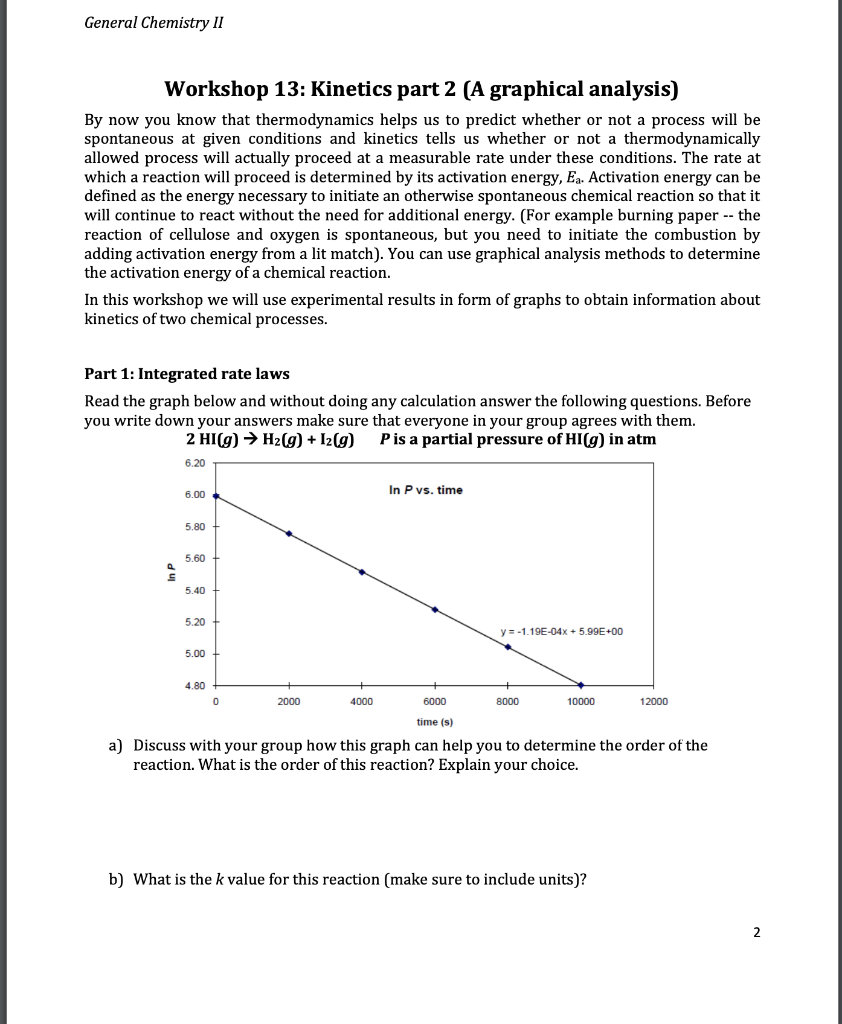
General Chemistry II Workshop 13: Kinetics part 2 (A graphical analysis) By now you know that thermodynamics helps us to predict whether or not a process will be spontaneous at given conditions and kinetics tells us whether or not a thermodynamically allowed process will actually proceed at a measurable rate under these conditions. The rate at which a reaction will proceed is determined by its activation energy, Ea. Activation energy can be defined as the energy necessary to initiate an otherwise spontaneous chemical reaction so that it will continue to react without the need for additional energy. (For example burning paper -- the reaction of cellulose and oxygen is spontaneous, but you need to initiate the combustion by adding activation energy from a lit match). You can use graphical analysis methods to determine the activation energy of a chemical reaction. In this workshop we will use experimental results in form of graphs to obtain information about kinetics of two chemical processes. Part 1: Integrated rate laws Read the graph below and without doing any calculation answer the following questions. Before you write down your answers make sure that everyone in your group agrees with them. 2 HI(g) → H₂(g) + I₂(g) P is a partial pressure of HI(g) in atm 6.20 In P vs. time 6.00 5.80 5.60 5.40 5.20 y=-1.19E-04x + 5.99E+00 5.00 4.80 0 2000 4000 6000 8000 10000 12000 time (s) a) Discuss with your group how this graph can help you to determine the order of the reaction. What is the order of this reaction? Explain your choice. b) What is the k value for this reaction (make sure to include units)? 2 In P