Page 1 of 1
Special notes: • Show all calculations, including determination of molar mass. • Do any algebra with variables, not numb
Posted: Fri May 06, 2022 8:30 am
by answerhappygod
- Special Notes Show All Calculations Including Determination Of Molar Mass Do Any Algebra With Variables Not Numb 1 (52.6 KiB) Viewed 28 times
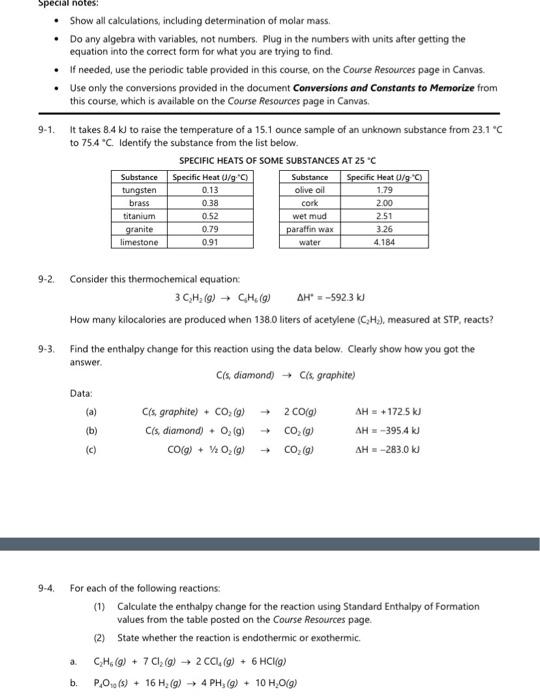
Special notes: • Show all calculations, including determination of molar mass. • Do any algebra with variables, not numbers. Plug in the numbers with units after getting the equation into the correct form for what you are trying to find. • If needed, use the periodic table provided in this course, on the Course Resources page in Canvas. • Use only the conversions provided in the document Conversions and Constants to Memorize from this course, which is available on the Course Resources page in Canvas. 9-1. It takes 8.4 kJ to raise the temperature of a 15.1 ounce sample of an unknown substance from 23.1 °C to 75.4 "C. Identify the substance from the list below. SPECIFIC HEATS OF SOME SUBSTANCES AT 25 °C Substance Specific Heat (J/g °C) Substance Specific Heat U/g °C) tungsten 0.13 olive oil 1.79 brass 0.38 cork 2.00 titanium 0.52 wet mud 2.51 granite 0.79 3.26 paraffin wax water limestone 0.91 4.184 9-2. Consider this thermochemical equation: 3 C₂H₂(g) → CH. (g) AH* = -592.3 kJ How many kilocalories are produced when 138.0 liters of acetylene (C₂H₂), measured at STP, reacts? 9-3. Find the enthalpy change for this reaction using the data below. Clearly show how you got the answer. C(s, diamond) → C(s, graphite) Data: (a) C(s, graphite) + CO₂(g) → 2 CO(g) AH+172.5 kJ (b) C(s, diamond) + O₂(g) → AH = -395.4 kJ CO₂ (g) CO(g) + 1/2O₂(g) → CO₂(g) (c) AH = -283.0 kJ 9-4. For each of the following reactions: (1) Calculate the enthalpy change for the reaction using Standard Enthalpy of Formation values from the table posted on the Course Resources page. (2) State whether the reaction is endothermic or exothermic. C₂H, (g) + 7 Cl₂ (g) → 2 CCI, (g) + 6 HCl(g) P₂0₁0 (5) + 16 H,(g) → 4 PH,(9) + 10 H_O(g) 3. b.