Page 1 of 1
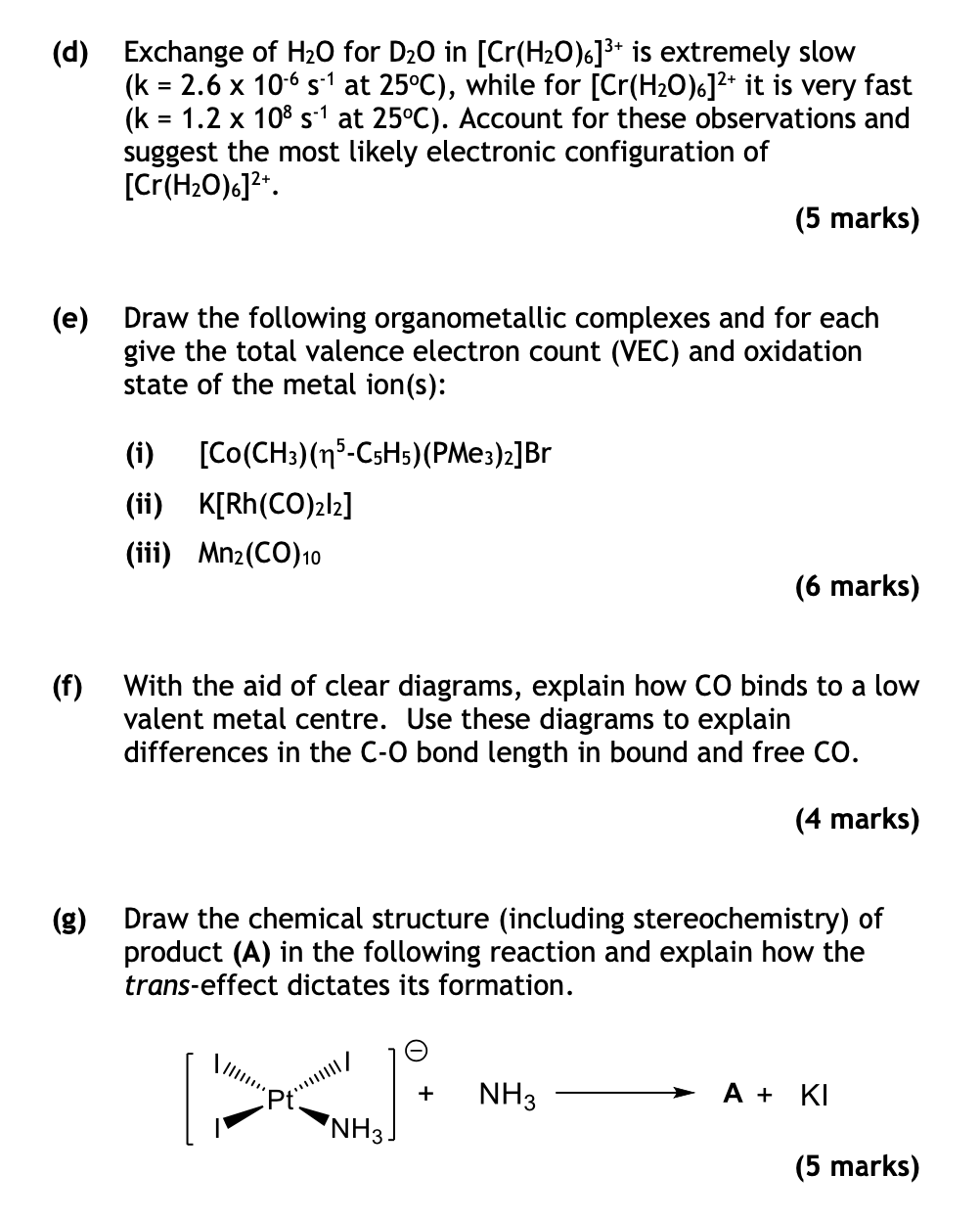
(d) Exchange of H₂O for D₂O in [Cr(H₂O)]³+ is extremely slow (k = 2.6 x 10⁻⁶ s-¹ at 25°C), while for [Cr(H₂O)]²+ it is v
Posted: Fri May 06, 2022 7:33 am
by answerhappygod
- D Exchange Of H O For D O In Cr H O Is Extremely Slow K 2 6 X 10 6 S At 25 C While For Cr H O It Is V 1 (142.73 KiB) Viewed 34 times
(d) Exchange of H₂O for D₂O in [Cr(H₂O)]³+ is extremely slow (k = 2.6 x 10⁻⁶ s-¹ at 25°C), while for [Cr(H₂O)]²+ it is very fast (k = 1.2 x 10⁸ s-¹ at 25°C). Account for these observations and suggest the most likely electronic configuration of [Cr(H₂O)6]²+. (5 marks) (e) Draw the following organometallic complexes and for each give the total valence electron count (VEC) and oxidation state of the metal ion(s): (i) [CO(CH3) (15-C5H5) (PMe3)2] Br (ii) K[Rh(CO)2l2] (iii) Mn2(CO) 10 (6 marks) (f) With the aid of clear diagrams, explain how CO binds to a low valent metal centre. Use these diagrams to explain differences in the C-O bond length in bound and free CO. (4 marks) (g) Draw the chemical structure (including stereochemistry) of product (A) in the following reaction and explain how the trans-effect dictates its formation. P/ NH3 A + KI NH3. + (5 marks)