Page 1 of 1
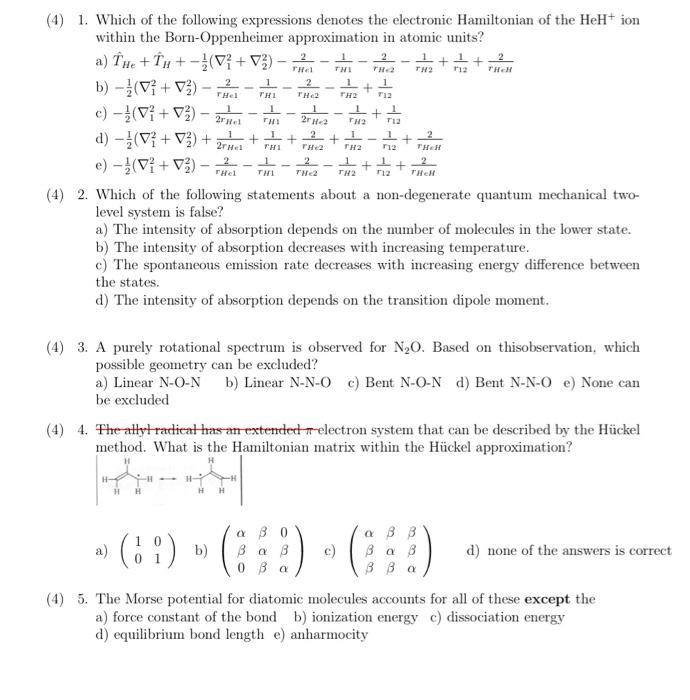
(4) 1. Which of the following expressions denotes the electronic Hamiltonian of the HeH+ ion within the Born-Oppenheimer
Posted: Fri May 06, 2022 7:26 am
by answerhappygod
- 4 1 Which Of The Following Expressions Denotes The Electronic Hamiltonian Of The Heh Ion Within The Born Oppenheimer 1 (66.96 KiB) Viewed 39 times
(4) 1. Which of the following expressions denotes the electronic Hamiltonian of the HeH+ ion within the Born-Oppenheimer approximation in atomic units? 1 a) THe + TH+-(V+). - 1 + 1/2₂2 +: TH-2 TH2 THCH 2 THel THI 2 TH 2 1 b) -(V+V) - 1 TH2 THel THI F12 1 c) -(V+V)- 2rjel THI 2rH2 TH2 2 d) -(V²+₂)+ + 2 TH 2 + F12 1 + 2rHel THI 2 1 "Hel THI 1 TH2 2. 1 TH2 THCH 2 1 e) -(V+)- + + TH=2 712 THCH (4) 2. Which of the following statements about a non-degenerate quantum mechanical two- level system is false? a) The intensity of absorption depends on the number of molecules in the lower state. b) The intensity of absorption decreases with increasing temperature. c) The spontaneous emission rate decreases with increasing energy difference between the states. d) The intensity of absorption depends on the transition dipole moment. (4) 3. A purely rotational spectrum is observed for N₂O. Based on thisobservation, which possible geometry can be excluded? a) Linear N-O-N b) Linear N-N-O c) Bent N-O-N d) Bent N-N-O e) None can be excluded (4) 4. The allyl radical has an extended electron system that can be described by the Hückel method. What is the Hamiltonian matrix within the Hückel approximation? # H H H H 0 - (9) - (89) - (5) a) b) a B c) a B d) none of the answers is correct 0 Ba Ba (4) 5. The Morse potential for diatomic molecules accounts for all of these except the a) force constant of the bond b) ionization energy c) dissociation energy d) equilibrium bond length e) anharmocity + 712