Page 1 of 1
(4) 1. Which of the following expressions denotes the electronic Hamiltonian of the HHe+ ion within the Born-Oppenheimer
Posted: Fri May 06, 2022 7:26 am
by answerhappygod
- 4 1 Which Of The Following Expressions Denotes The Electronic Hamiltonian Of The Hhe Ion Within The Born Oppenheimer 1 (63.64 KiB) Viewed 51 times
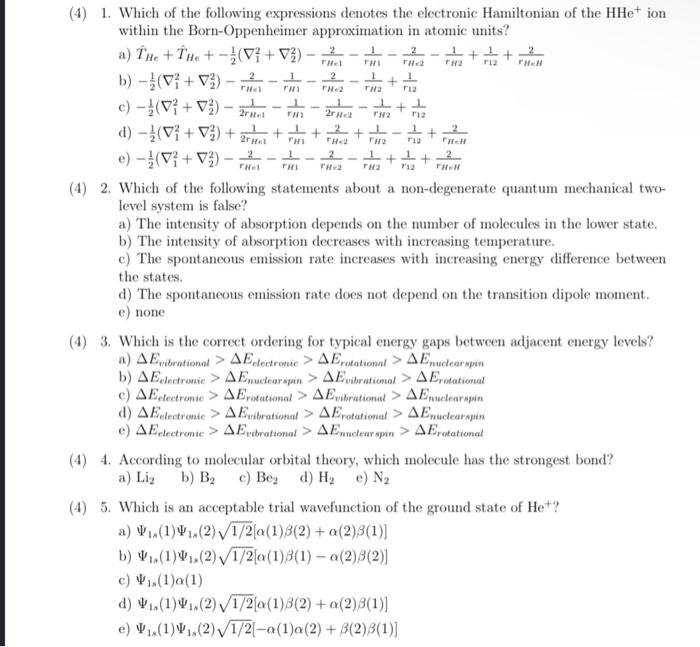
(4) 1. Which of the following expressions denotes the electronic Hamiltonian of the HHe+ ion within the Born-Oppenheimer approximation in atomic units? 2 1 2 a) The +The+(²+)- "Hel THI TH2 THEH 2 b) -(V+)- THel THI TH=2 TH2 F12 c) - (V+V) - ++ 2ral THE TH2 712 1 1 d) -(V+)+ + + 2rHel THI TH TH₂ 712 2 2 - - e) -(V+V) - 1 THI THel TH-2 TH2 712 THEH (4) 2. Which of the following statements about a non-degenerate quantum mechanical two- level system is false? a) The intensity of absorption depends on the number of molecules in the lower state. b) The intensity of absorption decreases with increasing temperature. c) The spontaneous emission rate increases with increasing energy difference between the states. d) The spontaneous emission rate does not depend on the transition dipole moment. e) none (4) 3. Which is the correct ordering for typical energy gaps between adjacent energy levels? a) AE,butil > AElectronic > Arational > AEnudearspin b) AElectronic > AEnuclearspin > AEvibrational > Erotational c) AERctronic > AEmuational > AE brational > AEnuclearspin d) AElectrovie > AE brational > AErotational > AEnudearspin e) AEclectronic > AEvibrational > AEnuclear spin > AErotational (4) 4. According to molecular orbital theory, which molecule has the strongest bond? a) Liz b) B₂ c) Be₂ d) H₂ e) N₂ (4) 5. Which is an acceptable trial wavefunction of the ground state of He+? a) V₁.(1) V₁.(2)√1/2[a(1)3(2) + a(2)3(1)] b) V₁.(1)V₁.(2)√1/2[a(1)3(1)-a(2),3(2)] c) V₁.(1)a(1) d) V₁.(1)₁. (2)√1/2[a(1)3(2) + a(2),3(1)] e) V₁.(1) V₁.(2)√/1/2-a(1)a (2) + 3(2),3(1)] 2012 + + + +++ ++++ TH2 THell