- Exercise 1 7 2 What Is A Derivative The Discussions In This Problem Holds For All Manifolds M But For Simplicities S 1 (55.73 KiB) Viewed 49 times
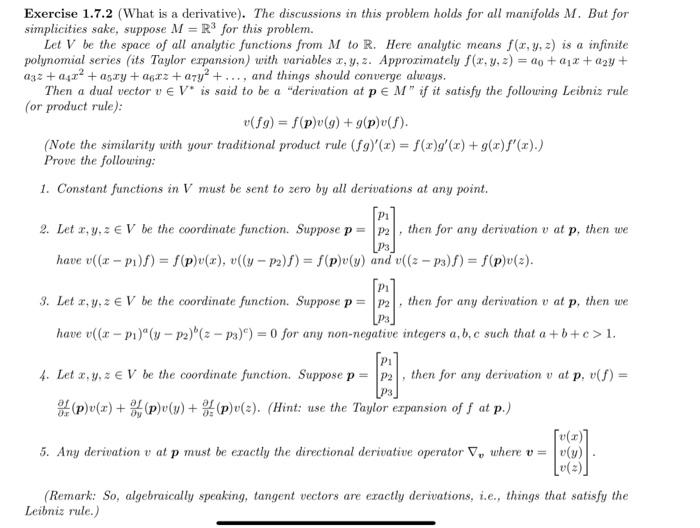
Exercise 1.7.2 (What is a derivative). The discussions in this problem holds for all manifolds M. But for simplicities sake, suppose M = R³ for this problem. Let V be the space of all analytic functions from M to R. Here analytic means f(x, y, z) is a infinite polynomial series (its Taylor expansion) with variables x, y, z. Approximately f(x, y, z)= ao+aiz+azy + azz + a² + aşxy + açxz+ary² +..., and things should converge always. Then a dual vector v EV is said to be a "derivation at pM" if it satisfy the following Leibniz rule (or product rule): v(fg) = f(p)v(g) + g(p)v(f). (Note the similarity with your traditional product rule (fg)'(x) = f(x)g'(x) + g(x)f'(x).) Prove the following: 1. Constant functions in V must be sent to zero by all derivations at any point. 2. Let x,y,z € V be the coordinate function. Suppose p= P2, then for any derivation v at p, then we have v((x-pi)f) = f(p)v(x), v((y-p2)f) = f(p)v(y) and v((z-p3)f) = f(p)v(z). Pi 3. Let x,y,z eV be the coordinate function. Suppose p= P2, then for any derivation v at p, then we have v((x-pi)(y-p2)(z-p3)) = 0 for any non-negative integers a, b, c such that a+b+c>1. 4. Let x, y, z EV be the coordinate function. Suppose p= P2, then for any derivation v at p. v(f) = (p)v(x) + (p)v(y) + (p)v(2). (Hint: use the Taylor expansion of f at p.) [v(x)] 5. Any derivation v at p must be exactly the directional derivative operator V, where v=v(y) (Remark: So, algebraically speaking, tangent vectors are exactly derivations, i.e., things that satisfy the Leibniz rule.)