Page 1 of 1
B.1. Add Poisson noise to the sinograms that contain your target (pixel- by-pixel using a random number generator). You
Posted: Fri May 06, 2022 6:55 am
by answerhappygod
- B 1 Add Poisson Noise To The Sinograms That Contain Your Target Pixel By Pixel Using A Random Number Generator You 1 (79.54 KiB) Viewed 45 times
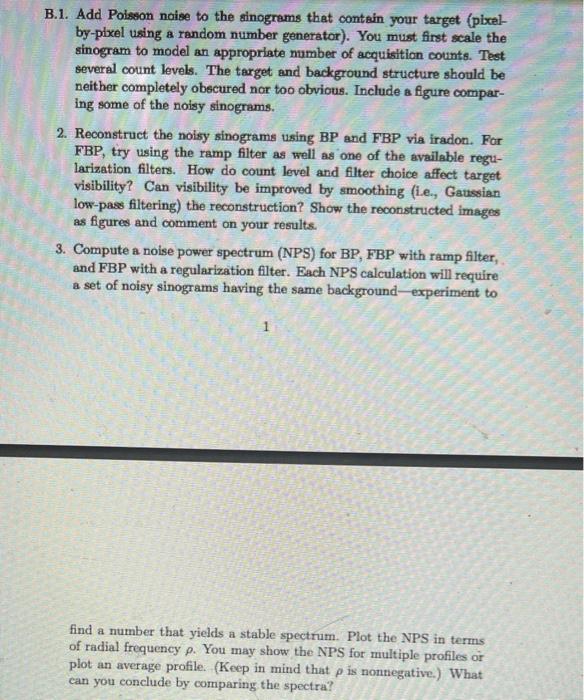
B.1. Add Poisson noise to the sinograms that contain your target (pixel- by-pixel using a random number generator). You must first scale the sinogram to model an appropriate number of acquisition counts. Test several count levels. The target and background structure should be neither completely obscured nor too obvious. Include a figure compar- ing some of the noisy sinograms. 2. Reconstruct the noisy sinograms using BP and FBP via iradon. For FBP, try using the ramp filter as well as one of the available regu- larization filters. How do count level and filter choice affect target visibility? Can visibility be improved by smoothing (i.e., Gaussian low-pass filtering) the reconstruction? Show the reconstructed images as figures and comment on your results. 3. Compute a noise power spectrum (NPS) for BP, FBP with ramp filter, and FBP with a regularization filter. Each NPS calculation will require a set of noisy sinograms having the same background-experiment to 1 find a number that yields a stable spectrum. Plot the NPS in terms of radial frequency p. You may show the NPS for multiple profiles or plot an average profile. (Keep in mind that p is nonnegative.) What can you conclude by comparing the spectra?