Page 1 of 1
3- Newtonian fluid A flows in a transient (not steady state) laminar flow in a channel formed by two horizontal parallel
Posted: Fri May 06, 2022 6:51 am
by answerhappygod
- 3 Newtonian Fluid A Flows In A Transient Not Steady State Laminar Flow In A Channel Formed By Two Horizontal Parallel 1 (312.02 KiB) Viewed 42 times
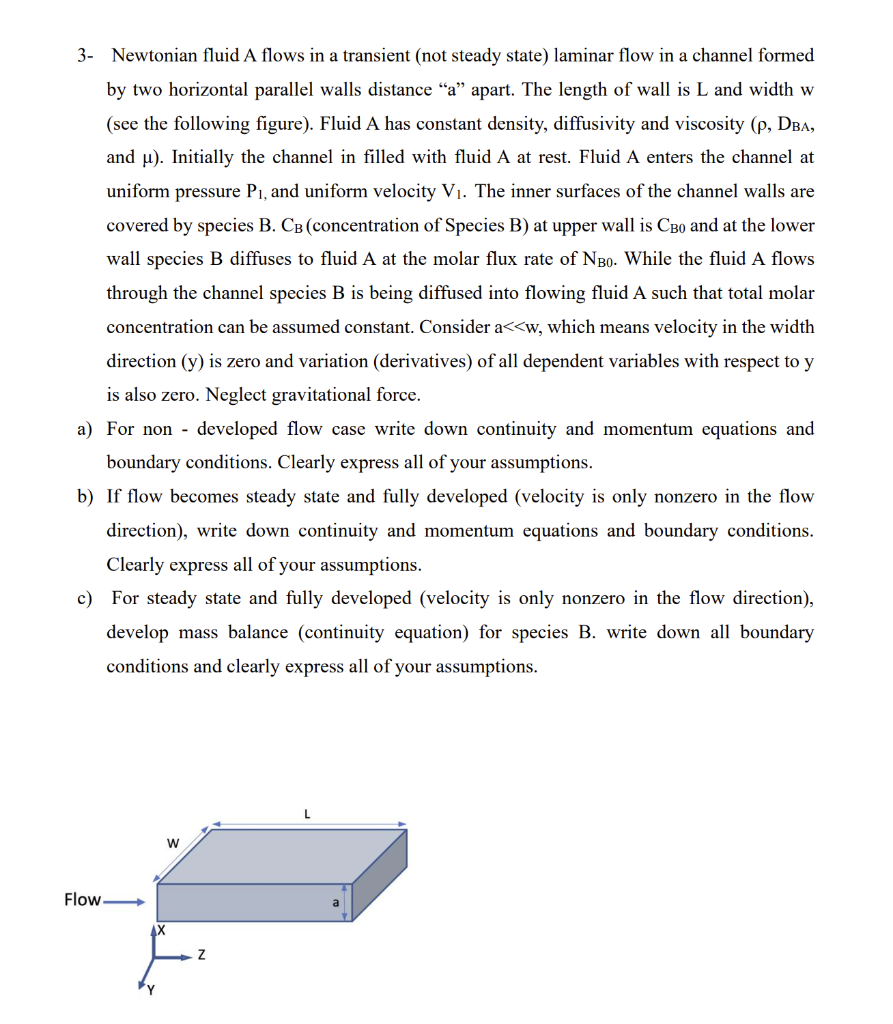
3- Newtonian fluid A flows in a transient (not steady state) laminar flow in a channel formed by two horizontal parallel walls distance "a" apart. The length of wall is L and width w (see the following figure). Fluid A has constant density, diffusivity and viscosity (p, DBA, and µ). Initially the channel in filled with fluid A at rest. Fluid A enters the channel at uniform pressure P₁, and uniform velocity V₁. The inner surfaces of the channel walls are covered by species B. CB (concentration of Species B) at upper wall is С30 and at the lower wall species B diffuses to fluid A at the molar flux rate of N30. While the fluid A flows through the channel species B is being diffused into flowing fluid A such that total molar concentration can be assumed constant. Consider a<<w, which means velocity in the width direction (y) is zero and variation (derivatives) of all dependent variables with respect to y is also zero. Neglect gravitational force. a) For non-developed flow case write down continuity and momentum equations and boundary conditions. Clearly express all of your assumptions. b) If flow becomes steady state and fully developed (velocity is only nonzero in the flow direction), write down continuity and momentum equations and boundary conditions. Clearly express all of your assumptions. c) For steady state and fully developed (velocity is only nonzero in the flow direction), develop mass balance (continuity equation) for species B. write down all boundary conditions and clearly express all of your assumptions. L W Flow-> AX Y Z