Page 1 of 1
A free-hanging pendulum of length L satisfies the differential equation d²0 -wo sin 0, dt² with a natural frequency of w
Posted: Fri May 06, 2022 6:44 am
by answerhappygod
- A Free Hanging Pendulum Of Length L Satisfies The Differential Equation D 0 Wo Sin 0 Dt With A Natural Frequency Of W 1 (312.41 KiB) Viewed 46 times
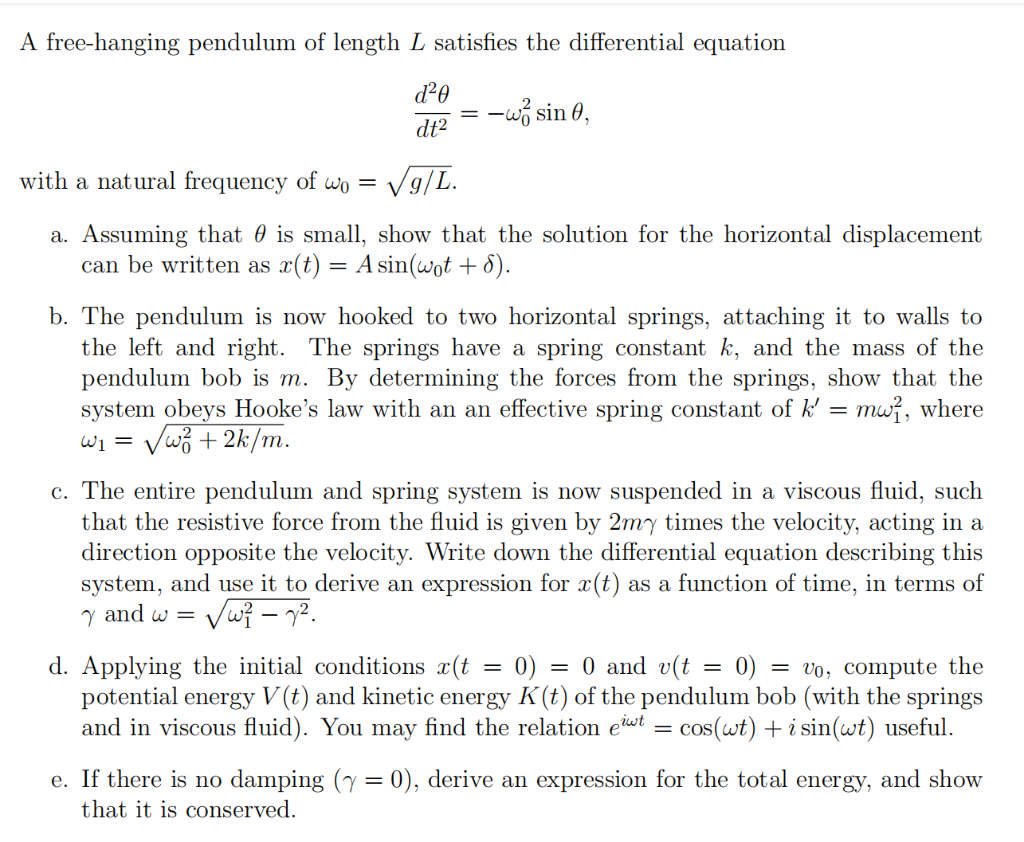
A free-hanging pendulum of length L satisfies the differential equation d²0 -wo sin 0, dt² with a natural frequency of wo = √g/L. a. Assuming that is small, show that the solution for the horizontal displacement can be written as x(t) = A sin(wot + 8). b. The pendulum is now hooked to two horizontal springs, attaching it to walls to the left and right. The springs have a spring constant k, and the mass of the pendulum bob is m. By determining the forces from the springs, show that the system obeys Hooke's law with an an effective spring constant of k' = mw, where w₁ = √√/w² +2k/m. c. The entire pendulum and spring system is now suspended in a viscous fluid, such that the resistive force from the fluid is given by 2my times the velocity, acting in a direction opposite the velocity. Write down the differential equation describing this system, and use it to derive an expression for x(t) as a function of time, in terms of y and w = √w² - 7². = d. Applying the initial conditions x(t = 0) = 0 and v(t 0) = Vo, compute the potential energy V(t) and kinetic energy K(t) of the pendulum bob (with the springs and in viscous fluid). You may find the relation et = cos(wt) + i sin(wt) useful. = e. If there is no damping (7 that it is conserved. = 0), derive an expression for the total energy, and show =