Page 1 of 1
One of the main arguments from Shapley in the Great Debate to argue that spiral nebulae could not be "island universes"
Posted: Fri May 06, 2022 6:37 am
by answerhappygod
- One Of The Main Arguments From Shapley In The Great Debate To Argue That Spiral Nebulae Could Not Be Island Universes 1 (90.09 KiB) Viewed 39 times
- One Of The Main Arguments From Shapley In The Great Debate To Argue That Spiral Nebulae Could Not Be Island Universes 2 (42.12 KiB) Viewed 39 times
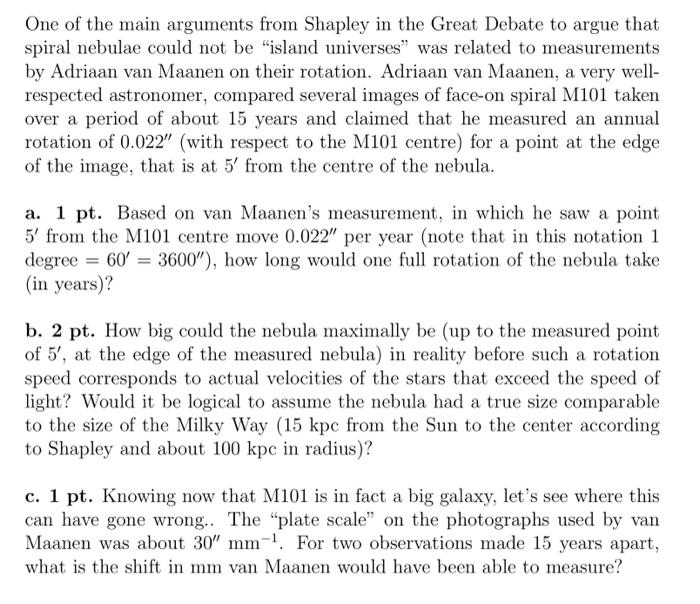
One of the main arguments from Shapley in the Great Debate to argue that spiral nebulae could not be "island universes" was related to measurements by Adriaan van Maanen on their rotation. Adriaan van Maanen, a very well- respected astronomer, compared several images of face-on spiral M101 taken over a period of about 15 years and claimed that he measured an annual rotation of 0.022" (with respect to the M101 centre) for a point at the edge of the image, that is at 5' from the centre of the nebula. a. 1 pt. Based on van Maanen's measurement, in which he saw a point 5' from the M101 centre move 0.022" per year (note that in this notation 1 degree = 60' = 3600"), how long would one full rotation of the nebula take (in years)? b. 2 pt. How big could the nebula maximally be (up to the measured point of 5', at the edge of the measured nebula) in reality before such a rotation speed corresponds to actual velocities of the stars that exceed the speed of light? Would it be logical to assume the nebula had a true size comparable to the size of the Milky Way (15 kpc from the Sun to the center according to Shapley and about 100 kpc in radius)? c. 1 pt. Knowing now that M101 is in fact a big galaxy, let's see where this can have gone wrong.. The "plate scale" on the photographs used by van Maanen was about 30" mm-¹. For two observations made 15 years apart, what is the shift in mm van Maanen would have been able to measure?
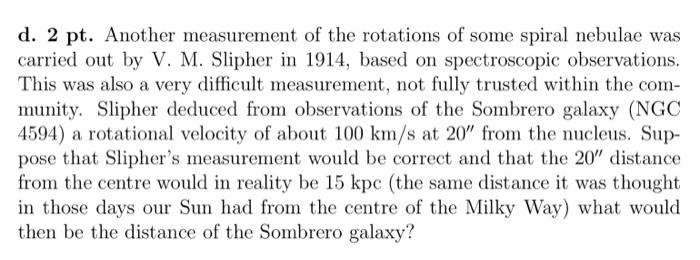
d. 2 pt. Another measurement of the rotations of some spiral nebulae was carried out by V. M. Slipher in 1914, based on spectroscopic observations. This was also a very difficult measurement, not fully trusted within the com- munity. Slipher deduced from observations of the Sombrero galaxy (NGC 4594) a rotational velocity of about 100 km/s at 20" from the nucleus. Sup- pose that Slipher's measurement would be correct and that the 20" distance from the centre would in reality be 15 kpc (the same distance it was thought in those days our Sun had from the centre of the Milky Way) what would then be the distance of the Sombrero galaxy?