Page 1 of 1
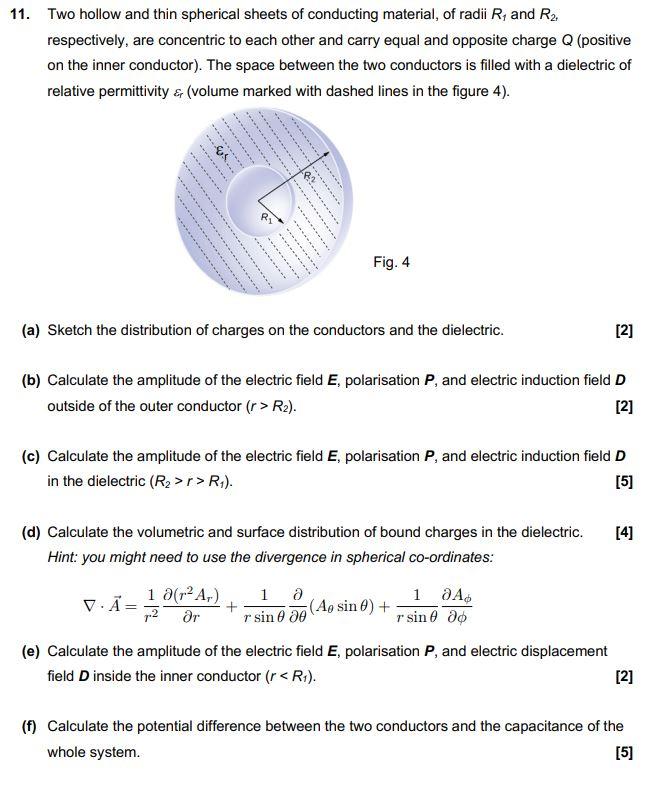
11. Two hollow and thin spherical sheets of conducting material, of radii R, and R2, respectively, are concentric to eac
Posted: Fri May 06, 2022 6:34 am
by answerhappygod
- 11 Two Hollow And Thin Spherical Sheets Of Conducting Material Of Radii R And R2 Respectively Are Concentric To Eac 1 (76.73 KiB) Viewed 41 times
11. Two hollow and thin spherical sheets of conducting material, of radii R, and R2, respectively, are concentric to each other and carry equal and opposite charge Q (positive on the inner conductor). The space between the two conductors is filled with a dielectric of relative permittivity & (volume marked with dashed lines in the figure 4). Fig. 4 (a) Sketch the distribution of charges on the conductors and the dielectric. [2] (b) Calculate the amplitude of the electric field E, polarisation P, and electric induction field D outside of the outer conductor (r > R₂). [2] (c) Calculate the amplitude of the electric field E, polarisation P, and electric induction field D in the dielectric (R₂>r> R₁). [5] (d) Calculate the volumetric and surface distribution of bound charges in the dielectric. [4] Hint: you might need to use the divergence in spherical co-ordinates: V. A = 1 0(r² Ar) 7.2 Ər 1 ə + r sin 0 00 (Ao sin 0) + 1 0A r sin do (e) Calculate the amplitude of the electric field E, polarisation P, and electric displacement field D inside the inner conductor (r< R₁). [2] (f) Calculate the potential difference between the two conductors and the capacitance of the whole system. [5] fos. RI