Page 1 of 1
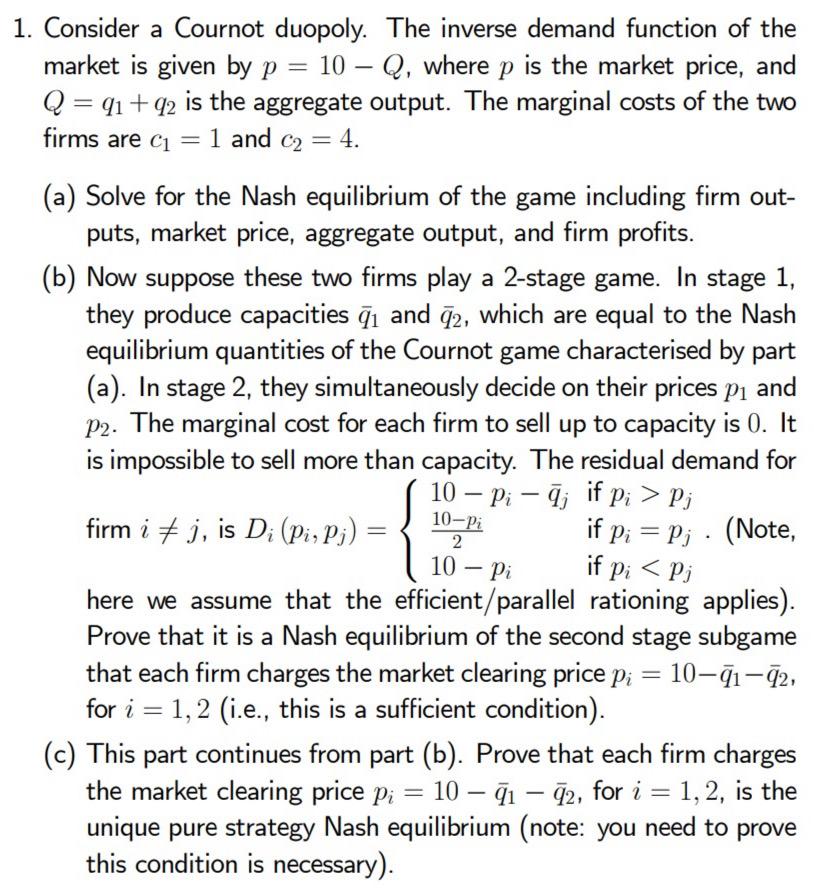
1. Consider a Cournot duopoly. The inverse demand function of the market is given by p = 10-Q, where p is the market pri
Posted: Fri May 06, 2022 6:22 am
by answerhappygod
- 1 Consider A Cournot Duopoly The Inverse Demand Function Of The Market Is Given By P 10 Q Where P Is The Market Pri 1 (131.25 KiB) Viewed 34 times
1. Consider a Cournot duopoly. The inverse demand function of the market is given by p = 10-Q, where p is the market price, and Q = 91 +92 is the aggregate output. The marginal costs of the two firms are c₁= 1 and c₂ = 4. (a) Solve for the Nash equilibrium of the game including firm out- puts, market price, aggregate output, and firm profits. (b) Now suppose these two firms play a 2-stage game. In stage 1, they produce capacities 9₁ and 92, which are equal to the Nash equilibrium quantities of the Cournot game characterised by part (a). In stage 2, they simultaneously decide on their prices p₁ and P2. The marginal cost for each firm to sell up to capacity is 0. It is impossible to sell more than capacity. The residual demand for 10 Pij if pi > Pj - Pi firm ij, is Di (Pi, Pj) 10-Pi 2 if pi = p; . (Note, Pi Pj if pi < Pj 10 - Pi Pi here we assume that the efficient/parallel rationing applies). Prove that it is a Nash equilibrium of the second stage subgame that each firm charges the market clearing price pi = 10-91-92, for i=1,2 (i.e., this is a sufficient condition). (c) This part continues from part (b). Prove that each firm charges the market clearing price pi 10-91-92, for i = 1, 2, is the unique pure strategy Nash equilibrium (note: you need to prove this condition is necessary).