Page 1 of 1
Let x be a random variable representing percentage change in neighborhood population in the past few years, and let y be
Posted: Thu May 05, 2022 9:04 pm
by answerhappygod
- Let X Be A Random Variable Representing Percentage Change In Neighborhood Population In The Past Few Years And Let Y Be 1 (140.53 KiB) Viewed 37 times
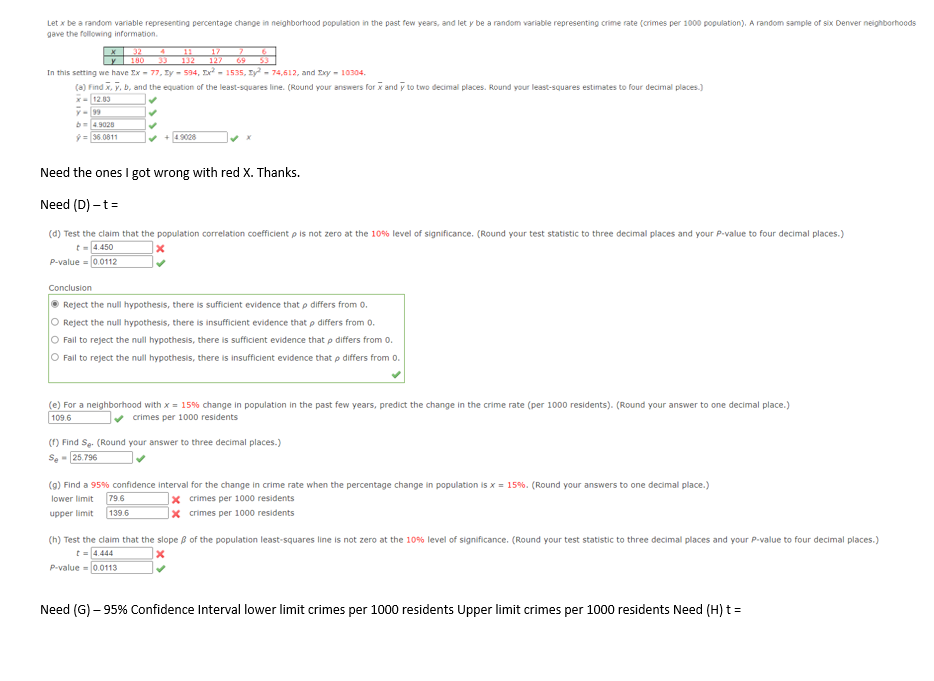
Let x be a random variable representing percentage change in neighborhood population in the past few years, and let y be a random variable representing crime rate (crimes per 1000 population). A random sample of six Denver neighborhoods gave the following information. 4 7 17 132 127 69 In this setting we have Ex-77, Ey-594, Ex² - 1535, ²74,612, and Exy - 10304. (a) Find x, y, b, and the equation of the least-squares line. (Round your answers for x and y to two decimal places. Round your least-squares estimates to four decimal places.) x-12.03 y-99 b=4.9028 = 36.0811 4.9028 Need the ones I got wrong with red X. Thanks. Need (D) -t = (d) Test the claim that the population correlation coefficient p is not zero at the 10% level of significance. (Round your test statistic to three decimal places and your P-value to four decimal places.) x t=4.450 P-value 0.0112 Conclusion Reject the null hypothesis, there is sufficient evidence that differs from 0. O Reject the null hypothesis, there is insufficient evidence that p differs from 0. O Fail to reject the null hypothesis, there is sufficient evidence that p differs from 0. O Fail to reject the null hypothesis, there is insufficient evidence that p differs from 0. (e) For a neighborhood with x = 15% change in population in the past few years, predict the change in the crime rate (per 1000 residents). (Round your answer to one decimal place.) 109.6 crimes per 1000 residents (f) Find Se. (Round your answer to three decimal places.) Se 25.796 (9) Find a 95% confidence interval for the change in crime rate when the percentage change in population is x = 15%. (Round your answers to one decimal place.) lower limit 79.6 x crimes per 1000 residents upper limit 139.6 x crimes per 1000 residents (h) Test the claim that the slope of the population least-squares line is not zero at the 10% level of significance. (Round your test statistic to three decimal places and your P-value to four decimal places.) t=4.444 P-value = 0.0113 Need (G)- 95% Confidence Interval lower limit crimes per 1000 residents Upper limit crimes per 1000 residents Need (H) t =