- 3 P Bist G Deshpande T W Kung R Laifa And C H Wang Ran An Ex Periment In 1995 To Compare The Light Intensities 1 (255.77 KiB) Viewed 18 times
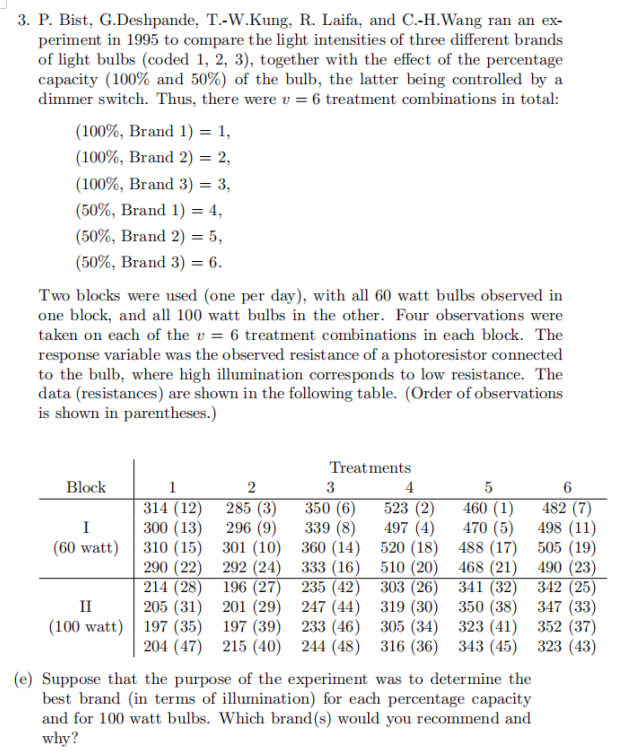
3. P. Bist, G.Deshpande, T.-W.Kung, R. Laifa, and C.-H.Wang ran an ex- periment in 1995 to compare the light intensities of three different brands of light bulbs (coded 1, 2, 3), together with the effect of the percentage capacity (100% and 50%) of the bulb, the latter being controlled by a dimmer switch. Thus, there were v = 6 treatment combinations in total: (100%, Brand 1) = 1, (100%, Brand 2) = 2, (100%, Brand 3) = 3, (50%, Brand 1) = 4, (50%, Brand 2) = 5, (50%, Brand 3) = 6. Two blocks were used (one per day), with all 60 watt bulbs observed in one block, and all 100 watt bulbs in the other. Four observations were taken on each of the v= 6 treatment combinations in each block. The response variable was the observed resistance of a photoresistor connected to the bulb, where high illumination corresponds to low resistance. The data (resistances) are shown in the following table. (Order of observations is shown in parentheses.) Treatments Block 1 2 3 4 5 6 482 (7) 314 (12) 285 (3) 350 (6) 523 (2) 460 (1) I 300 (13) 296 (9) 339 (8) 497 (4) 470 (5) 498 (11) (60 watt) 310 (15) 301 (10) 360 (14) 520 (18) 488 (17) 505 (19) 290 (22) 292 (24) 333 (16) 510 (20) 468 (21) 490 (23) 214 (28) 196 (27) 235 (42) 303 (26) 341 (32) 342 (25) 205 (31) 201 (29) 247 (44) 319 (30) 350 (38) 347 (33) II (100 watt) 197 (35) 197 (39) 233 (46) 305 (34) 323 (41) 352 (37) 204 (47) 215 (40) 244 (48) 316 (36) 343 (45) 323 (43) (e) Suppose that the purpose of the experiment was to determine the best brand (in terms of illumination) for each percentage capacity and for 100 watt bulbs. Which brand (s) would you recommend and why?