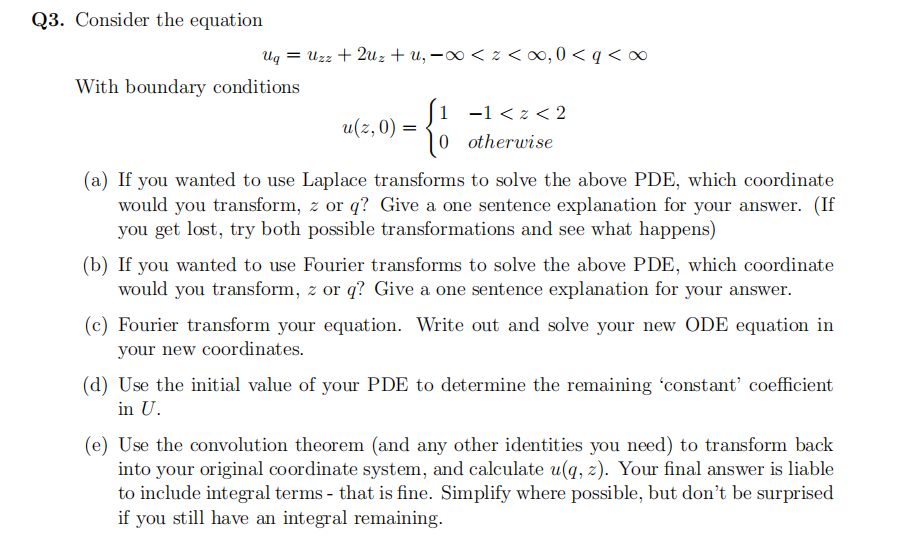
Q3. Consider the equation Ug = Uzz + 2Uz +U, -∞< z <∞,0
Posted: Thu May 05, 2022 6:45 pm
- Q3 Consider The Equation Ug Uzz 2uz U Z 0 Q With Boundary Conditions U Z 0 1 1 2 0 Otherwise A 1 (93.46 KiB) Viewed 31 times
Q3. Consider the equation Ug = Uzz + 2Uz +U, -∞< z <∞,0<q <∞ With boundary conditions u(z,0): 1 −1 << < 2 0 otherwise (a) If you wanted to use Laplace transforms to solve the above PDE, which coordinate would you transform, z or q? Give a one sentence explanation for your answer. (If you get lost, try both possible transformations and see what happens) (b) If you wanted to use Fourier transforms to solve the above PDE, which coordinate would you transform, z or q? Give a one sentence explanation for your answer. (c) Fourier transform your equation. Write out and solve your new ODE equation in your new coordinates. (d) Use the initial value of your PDE to determine the remaining 'constant' coefficient in U. (e) Use the convolution theorem (and any other identities you need) to transform back into your original coordinate system, and calculate u(q, z). Your final answer is liable to include integral terms - that is fine. Simplify where possible, but don't be surprised if you still have an integral remaining.
Posted: Thu May 05, 2022 6:45 pm
- Q3 Consider The Equation Ug Uzz 2uz U Z 0 Q With Boundary Conditions U Z 0 1 1 2 0 Otherwise A 1 (93.46 KiB) Viewed 31 times