- 2 This Question Carries 30 Marks In Total This Question Concerns The Heat Equation In Two Spatial Dimensions For U T 1 (137.58 KiB) Viewed 32 times
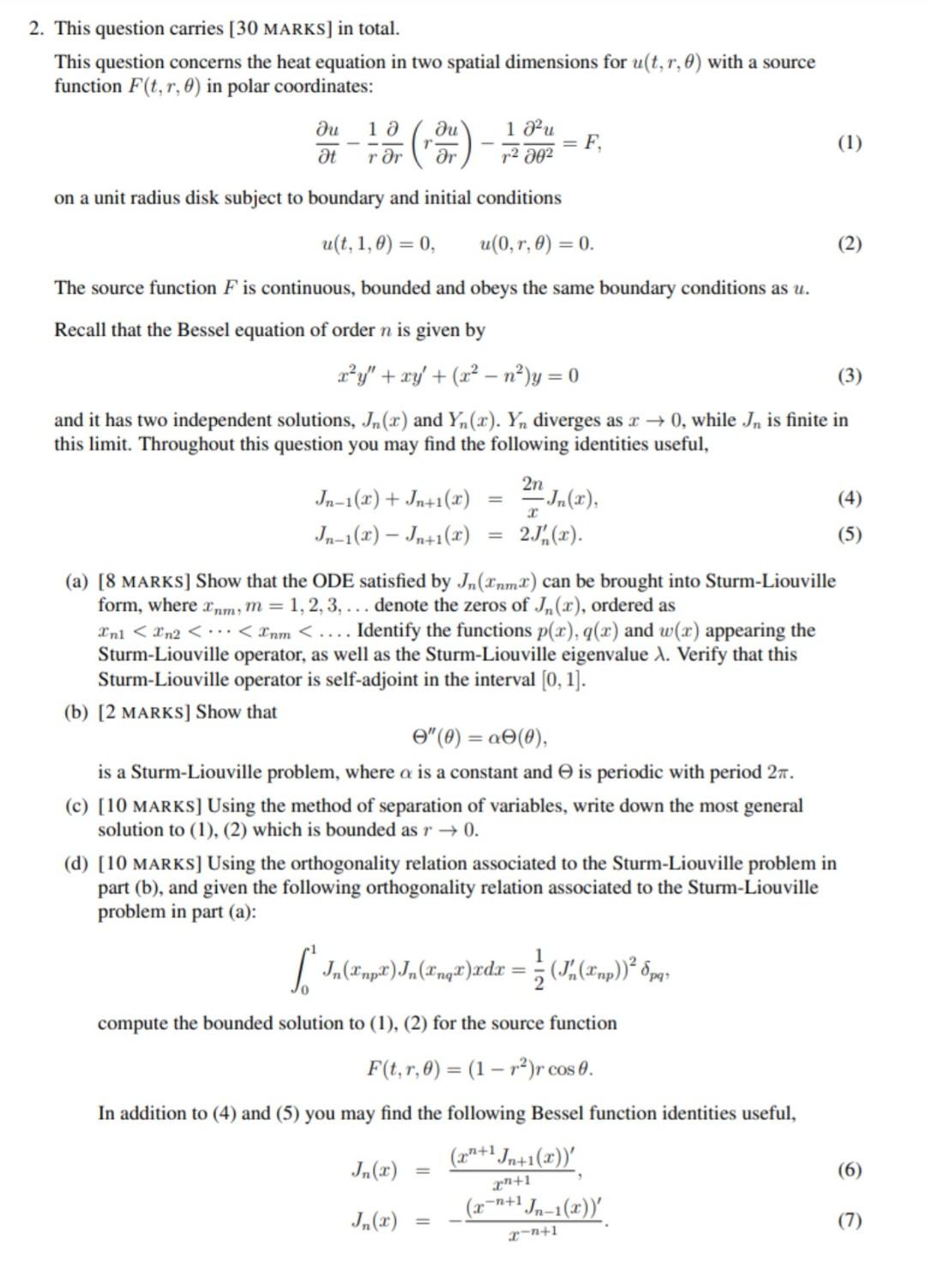
2. This question carries [30 MARKS] in total. This question concerns the heat equation in two spatial dimensions for u(t, r, 0) with a source function F(t, r, 0) in polar coordinates: ди 18 18²u (rou) = F. (1) Ət rər 2 002 on a unit radius disk subject to boundary and initial conditions u(t, 1,0) = 0, u(0,r, 0) = 0. The source function F is continuous, bounded and obeys the same boundary conditions as u. Recall that the Bessel equation of order n is given by x²y" + xy' + (x² − n²)y = 0 (3) and it has two independent solutions, Jn (x) and Yn (r). Yn diverges as x→ 0, while Jn is finite in this limit. Throughout this question you may find the following identities useful, 2n = Jn(x), Jn-1(x) + Jn+1(x) Jn-1(x) - Jn+1(x) (4) (5) = 2.J₁(x). (a) [8 MARKS] Show that the ODE satisfied by Jn (nm) can be brought into Sturm-Liouville form, where nm, m = 1, 2, 3, ... denote the zeros of Jn (r), ordered as Xn1 <£n2 << nm <.... Identify the functions p(x), q(x) and w(x) appearing the Sturm-Liouville operator, as well as the Sturm-Liouville eigenvalue A. Verify that this Sturm-Liouville operator is self-adjoint in the interval [0, 1]. (b) [2 MARKS] Show that 0" (0) = a0(0), is a Sturm-Liouville problem, where a is a constant and is periodic with period 27. (c) [10 MARKS] Using the method of separation of variables, write down the most general solution to (1), (2) which is bounded as r → 0. (d) [10 MARKS] Using the orthogonality relation associated to the Sturm-Liouville problem in part (b), and given the following orthogonality relation associated to the Sturm-Liouville problem in part (a): [ "* In(Emp²2) In (Engx) xdx = = (Jn (#np))² Spq; compute the bounded solution to (1), (2) for the source function F(t, r,0)= (1-²)r cos 0. In addition to (4) and (5) you may find the following Bessel function identities useful, (x+¹Jn+1(x))' Jn(x) (6) x+1 (x-n+¹ Jn-1(x))' Jn(x) (7) x-n+1