- Power Series Are Typically Used To Break A Function Into A Sequence Of Numbers The Taylor Coeffi Cients Of The Funct 1 (130.99 KiB) Viewed 38 times
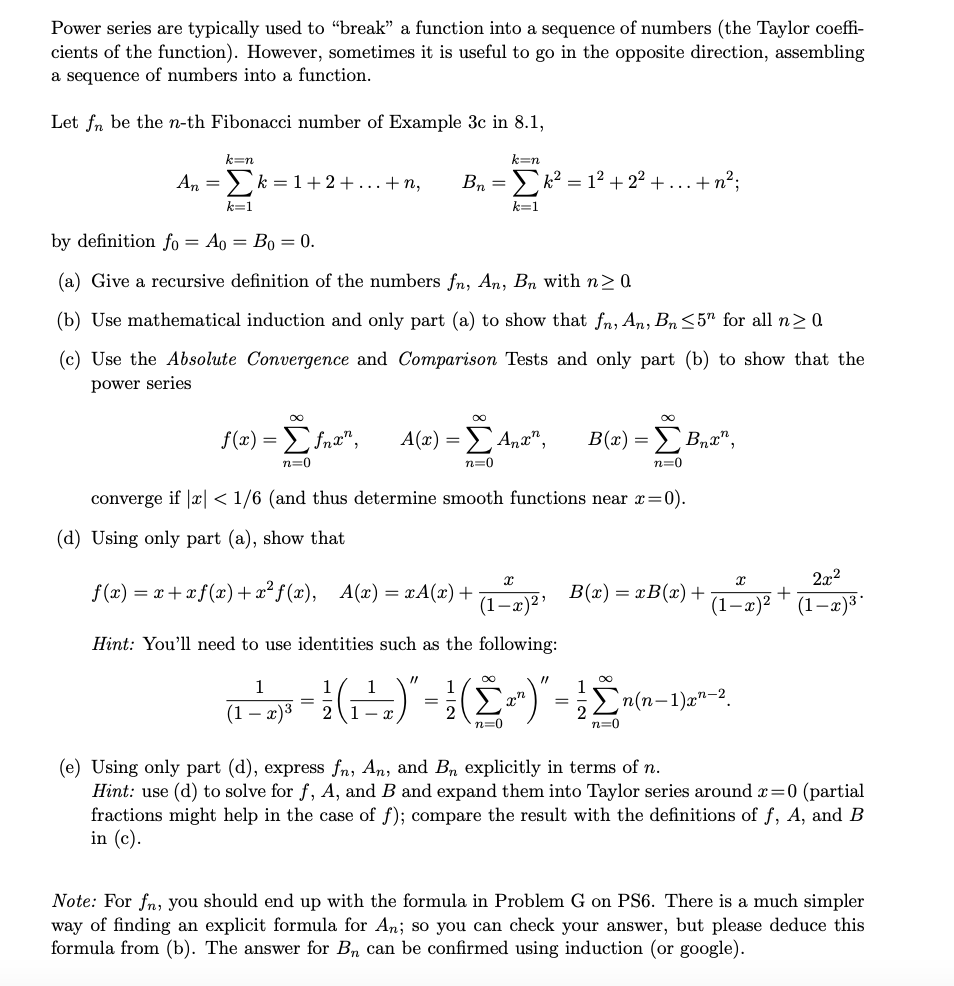
Power series are typically used to "break" a function into a sequence of numbers (the Taylor coeffi- cients of the function). However, sometimes it is useful to go in the opposite direction, assembling a sequence of numbers into a function. Let fn be the n-th Fibonacci number of Example 3c in 8.1, k=n k=n An = Σκ=1+2+...+η, B₁=k² = 1² +2² + n²; k=1 k=1 by definition fo = Ao = Bo = 0. (a) Give a recursive definition of the numbers fn, An, Bn with n ≥ 0 (b) Use mathematical induction and only part (a) to show that fn, An, Bn ≤5" for all n≥ 0 Convergence and Comparison Tests and only part (b) to show that the (c) Use the Absolute power series f(x) = Σ fnan, - Σ²² A(x) = Σ Ang", B(x) = Σ Bna", - Σ B₁² n=0 n=0 n=0 converge if x < 1/6 (and thus determine smooth functions near x=0). (d) Using only part (a), show that x X 2x² f(x) = x+xf(x)+x²f(x), A(x)=xA(x) + B(x) = xB(x) + (1-x)²¹ (1-x)² (1-x)³ Hint: You'll need to use identities such as the following: 1 a-²-1 (²-)" - (-)" - ½ Σn(n-1)²²-². Σ = (1-x)³ 2 x 2 n=0 n=0 (e) Using only part (d), express fn, An, and Bn explicitly in terms of n. Hint: use (d) to solve for f, A, and B and expand them into Taylor series around x=0 (partial fractions might help in the case of f); compare the result with the definitions of f, A, and B in (c). Note: For fn, you should end up with the formula in Problem G on PS6. There is a much simpler way of finding an explicit formula for An; so you can check your answer, but please deduce this formula from (b). The answer for Bn can be confirmed using induction (or google). +