- Let K Be Field Let R K X N And Let F N Fm X1 Xn R Show That F K Kn 0 Fm K1 1 1 (105.43 KiB) Viewed 31 times
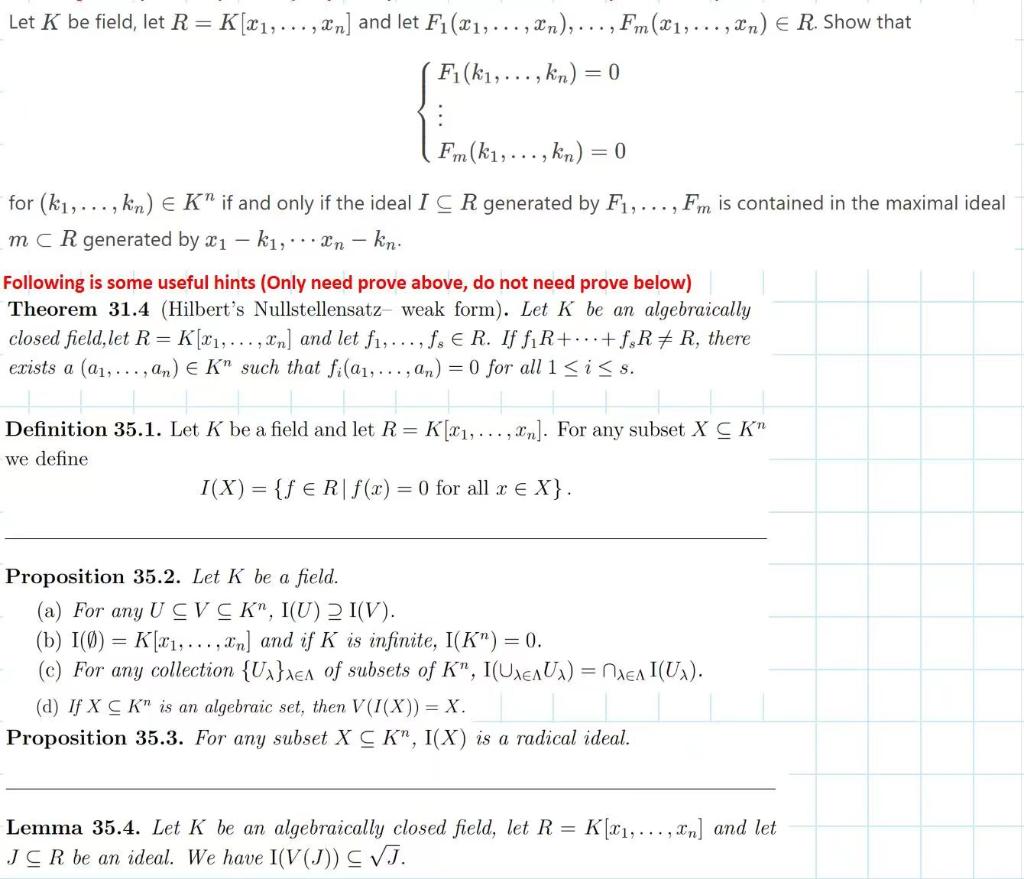
Let K be field, let R = K[x₁,...,n] and let F₁(₁,...,n),..., Fm (x1,...,xn) € R. Show that F₁(k₁,..., kn) = 0 Fm(k1,. 1..... , kn) = 0 for (k₁,..., kn) K" if and only if the ideal ICR generated by F₁,..., Fm is contained in the maximal ideal m CR generated by ₁ - k₁, xn - kn. Following is some useful hints (Only need prove above, do not need prove below) Theorem 31.4 (Hilbert's Nullstellensatz weak form). Let K be an algebraically closed field, let R = K[x₁,...,n] and let f₁,..., fs E R. If f₁R++fR ‡ R, there exists a (a₁,...,an) EK" such that fi(a₁,..., an) = 0 for all 1 ≤ i ≤ s. Definition 35.1. Let K be a field and let R = K[x₁,...,n]. For any subset XC Kn we define I(X) = {f € R| f(x) = 0 for all x € X}. Proposition 35.2. Let K be a field. (a) For any UCVCK", I(U) 2 I(V). (b) I(0) = K[x₁,...,n] and if K is infinite, I(K) = 0. (c) For any collection {UAAEA of subsets of K", I(UXEAUX) = AEA I(UA). (d) If X CK" is an algebraic set, then V(I(X)) = X. Proposition 35.3. For any subset XCK", I(X) is a radical ideal. Lemma 35.4. Let K be an algebraically closed field, let R = K[x₁,...,n] and let JCR be an ideal. We have I(V(J)) ≤ √J.