Page 1 of 1
1. Construct a function on [0, 1] that is not Riemann Integrable. Prove that it is not integrable by showing that U(f) >
Posted: Thu May 05, 2022 6:33 pm
by answerhappygod
- 1 Construct A Function On 0 1 That Is Not Riemann Integrable Prove That It Is Not Integrable By Showing That U F 1 (169.12 KiB) Viewed 41 times
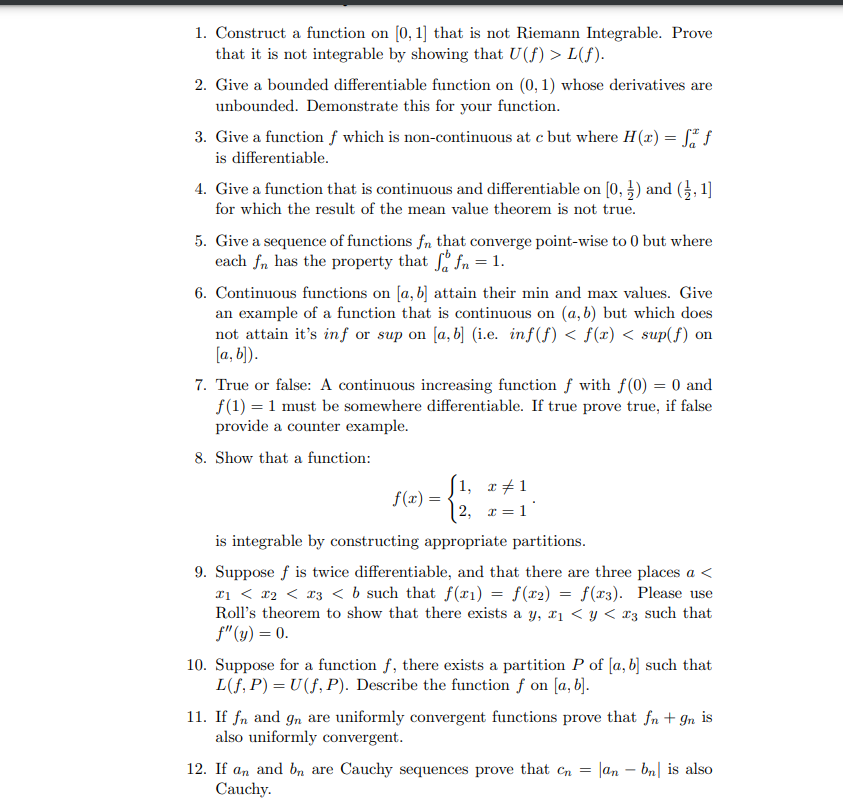
1. Construct a function on [0, 1] that is not Riemann Integrable. Prove that it is not integrable by showing that U(f) > L(f). 2. Give a bounded differentiable function on (0, 1) whose derivatives are unbounded. Demonstrate this for your function. 3. Give a function f which is non-continuous at c but where H(x) = f f is differentiable. 4. Give a function that is continuous and differentiable on [0,) and (1,1] for which the result of the mean value theorem is not true. 5. Give a sequence of functions fn that converge point-wise to 0 but where each fn has the property that ffn = 1. 6. Continuous functions on [a, b] attain their min and max values. Give an example of a function that is continuous on (a, b) but which does not attain it's in f or sup on [a, b] (i.e. inf(f) < f(x) < sup(f) on [a, b]). 7. True or false: A continuous increasing function f with f(0) = 0 and f(1) = 1 must be somewhere differentiable. If true prove true, if false provide a counter example. 8. Show that a function: 1, x 1 f(x)= 2, x=1 is integrable by constructing appropriate partitions. 9. Suppose f is twice differentiable, and that there are three places a < T1 < x2 < x3 < b such that f(x₁) = f(x2) = f(x3). Please use Roll's theorem to show that there exists a y, ₁ < y < 3 such that f" (y) = 0. 10. Suppose for a function f, there exists a partition P of [a, b] such that L(f, P) = U(f, P). Describe the function f on [a, b]. 11. If fn and gn are uniformly convergent functions prove that fn + gn is also uniformly convergent. 12. If an and bn are Cauchy sequences prove that cn = an-bn is also Cauchy. =