Page 1 of 1
Q1. (a) Quantify the relative advantage of a three-phase system over an equivalent three single-phase circuits in terms
Posted: Thu May 05, 2022 2:25 pm
by answerhappygod
- Q1 A Quantify The Relative Advantage Of A Three Phase System Over An Equivalent Three Single Phase Circuits In Terms 1 (85.47 KiB) Viewed 44 times
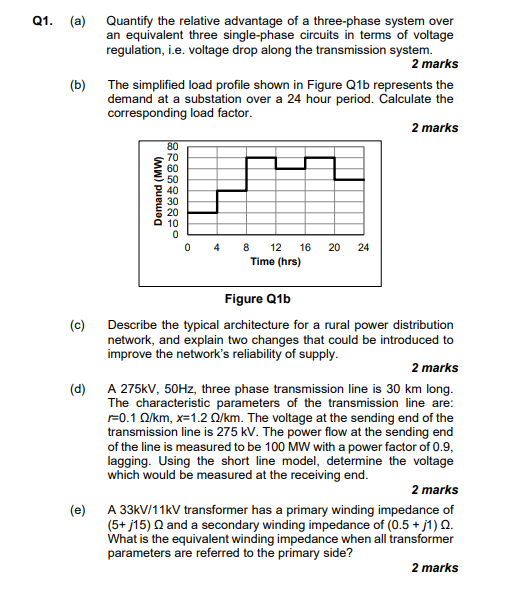
Q1. (a) Quantify the relative advantage of a three-phase system over an equivalent three single-phase circuits in terms of voltage regulation, i.e. voltage drop along the transmission system. 2 marks (b) The simplified load profile shown in Figure Q1b represents the demand at a substation over a 24 hour period. Calculate the corresponding load factor. 2 marks 80 70 60 50 40 30 8 12 16 20 24 Time (hrs) Figure Q1b Describe the typical architecture for a rural power distribution network, and explain two changes that could be introduced to improve the network's reliability of supply. 2 marks A 275kV, 50Hz, three phase transmission line is 30 km long. The characteristic parameters of the transmission line are: r=0.1 02/km, x=1.20/km. The voltage at the sending end of the transmission line is 275 kV. The power flow at the sending end of the line is measured to be 100 MW with a power factor of 0.9, lagging. Using the short line model, determine the voltage which would be measured at the receiving end. 2 marks (e) A 33kV/11kV transformer has a primary winding impedance of (5+j15) Q and a secondary winding impedance of (0.5 + j1) 0. What is the equivalent winding impedance when all transformer parameters are referred to the primary side? 2 marks (c) (d) Demand (MW) 4