Page 1 of 1
1. An intersection is designed to operate under a three-phase signal timing plan. This includes a leading protected left
Posted: Thu May 05, 2022 12:07 pm
by answerhappygod
- 1 An Intersection Is Designed To Operate Under A Three Phase Signal Timing Plan This Includes A Leading Protected Left 1 (208.73 KiB) Viewed 33 times
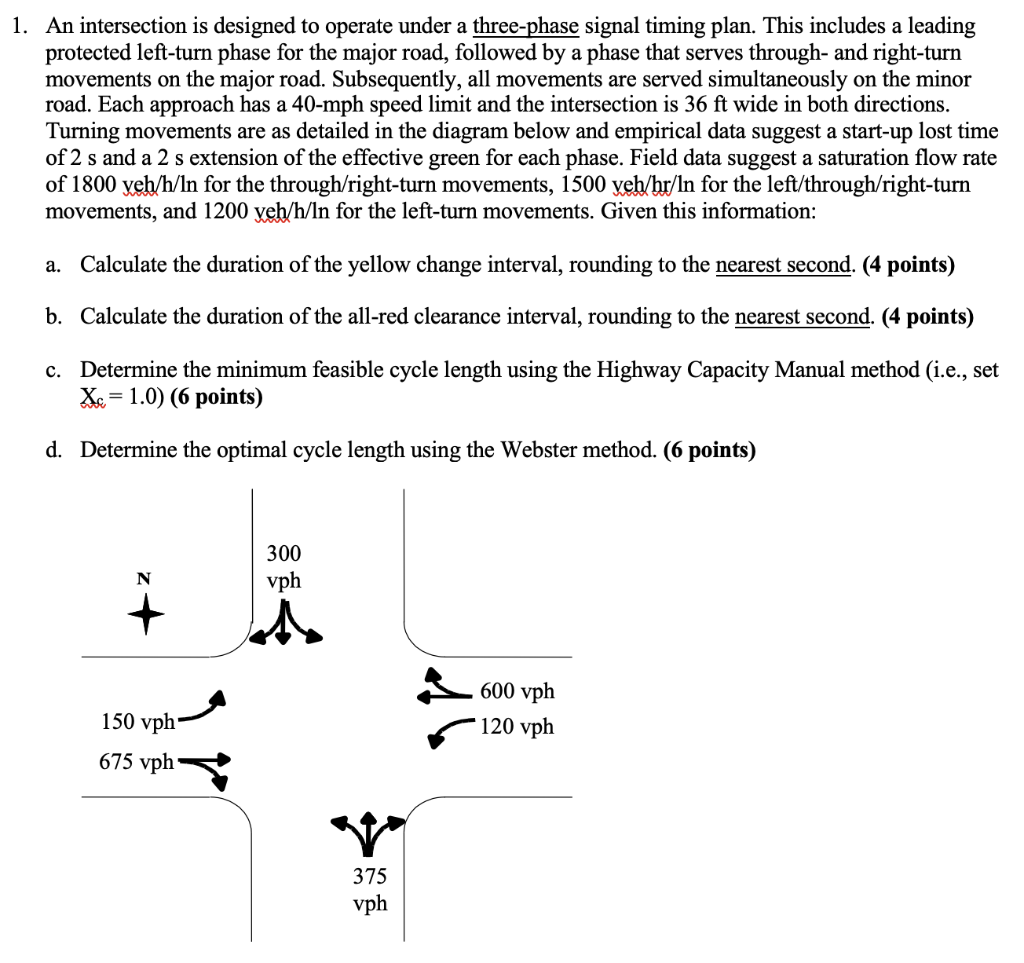
1. An intersection is designed to operate under a three-phase signal timing plan. This includes a leading protected left-turn phase for the major road, followed by a phase that serves through- and right-turn movements on the major road. Subsequently, all movements are served simultaneously on the minor road. Each approach has a 40-mph speed limit and the intersection is 36 ft wide in both directions. Turning movements are as detailed in the diagram below and empirical data suggest a start-up lost time of 2 s and a 2 s extension of the effective green for each phase. Field data suggest a saturation flow rate of 1800 yeh/h/ln for the through/right-turn movements, 1500 veh/hr/ln for the left/through/right-turn movements, and 1200 veh/h/ln for the left-turn movements. Given this information: a. Calculate the duration of the yellow change interval, rounding to the nearest second. (4 points) b. Calculate the duration of the all-red clearance interval, rounding to the nearest second. (4 points) c. Determine the minimum feasible cycle length using the Highway Capacity Manual method (i.e., set X = 1.0) (6 points) d. Determine the optimal cycle length using the Webster method. (6 points) 300 N vph 600 vph 120 vph 150 vph 675 vph- 375 vph