- Currently Soft Drink Manufacturers In Autarka Pay A Tax Of 0 40 On Each Bottle Of Drink They Sell The Revenue From Th 1 (57.39 KiB) Viewed 53 times
- Currently Soft Drink Manufacturers In Autarka Pay A Tax Of 0 40 On Each Bottle Of Drink They Sell The Revenue From Th 2 (58.31 KiB) Viewed 53 times
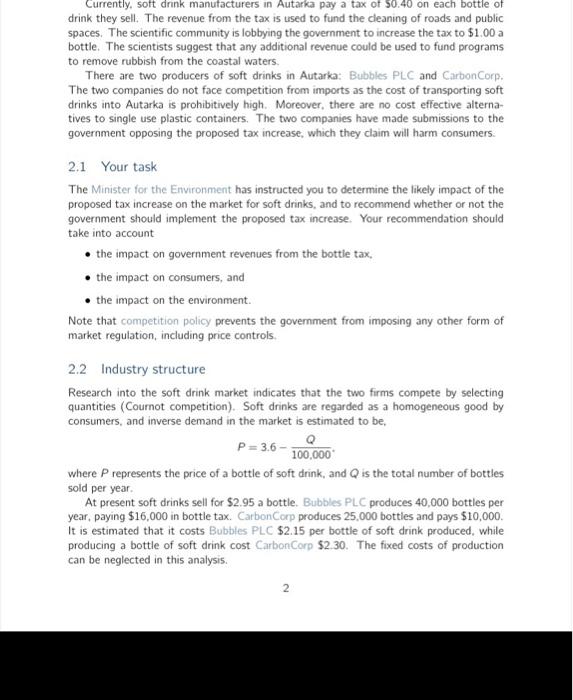
Currently, soft drink manufacturers in Autarka pay a tax of $0.40 on each bottle of drink they sell. The revenue from the tax is used to fund the cleaning of roads and public spaces. The scientific community is lobbying the government to increase the tax to $1.00 a bottle. The scientists suggest that any additional revenue could be used to fund programs to remove rubbish from the coastal waters. There are two producers of soft drinks in Autarka: Bubbles PLC and Carbon Corp. The two companies do not face competition from imports as the cost of transporting soft drinks into Autarka is prohibitively high. Moreover, there are no cost effective alterna- tives to single use plastic containers. The two companies have made submissions to the government opposing the proposed tax increase, which they claim will harm consumers. 2.1 Your task The Minister for the Environment has instructed you to determine the likely impact of the proposed tax increase on the market for soft drinks, and to recommend whether or not the government should implement the proposed tax increase. Your recommendation should take into account the impact on government revenues from the bottle tax, the impact on consumers, and the impact on the environment. Note that competition policy prevents the government from imposing any other form of market regulation, including price controls. 2.2 Industry structure Research into the soft drink market indicates that the two firms compete by selecting quantities (Cournot competition). Soft drinks are regarded as a homogeneous good by consumers, and inverse demand in the market is estimated to be, P= 3.6- 100,000 where P represents the price of a bottle of soft drink, and Q is the total number of bottles sold per year. At present soft drinks sell for $2.95 a bottle. Bubbles PLC produces 40,000 bottles per year, paying $16,000 in bottle tax. CarbonCorp produces 25,000 bottles and pays $10,000. It is estimated that it costs Bubbles PLC $2.15 per bottle of soft drink produced, while producing a bottle of soft drink cost CarbonCorp $2.30. The fixed costs of production can be neglected in this analysis. 2
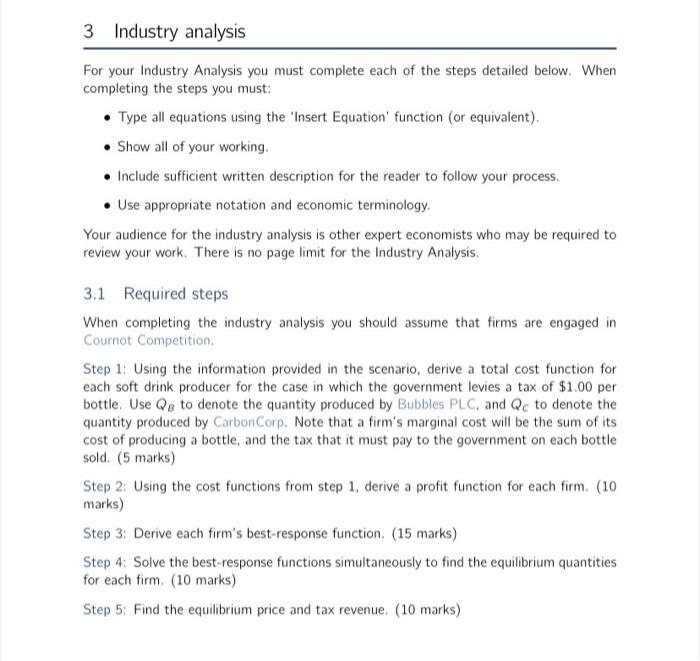
3 Industry analysis For your Industry Analysis you must complete each of the steps detailed below. When completing the steps you must: • Type all equations using the 'Insert Equation function (or equivalent). • Show all of your working. • Include sufficient written description for the reader to follow your process. • Use appropriate notation and economic terminology. Your audience for the industry analysis is other expert economists who may be required to review your work. There is no page limit for the Industry Analysis. 3.1 Required steps When completing the industry analysis you should assume that firms are engaged in Cournot Competition. Step 1: Using the information provided in the scenario, derive a total cost function for each soft drink producer for the case in which the government levies a tax of $1.00 per bottle. Use Qg to denote the quantity produced by Bubbles PLC, and Qc to denote the quantity produced by CarbonCorp. Note that a firm's marginal cost will be the sum of its cost of producing a bottle, and the tax that it must pay to the government on each bottle sold. (5 marks) Step 2: Using the cost functions from step 1, derive a profit function for each firm. (10 marks) Step 3: Derive each firm's best-response function. (15 marks) Step 4: Solve the best-response functions simultaneously to find the equilibrium quantities for each firm. (10 marks) Step 5: Find the equilibrium price and tax revenue. (10 marks)