Page 1 of 1
Question 2. [Total 14 points] Consider the following simultaneous-move game: "Divide-the-Dollars". There are two players
Posted: Thu May 05, 2022 6:19 am
by answerhappygod
- Question 2 Total 14 Points Consider The Following Simultaneous Move Game Divide The Dollars There Are Two Players 1 (119.52 KiB) Viewed 38 times
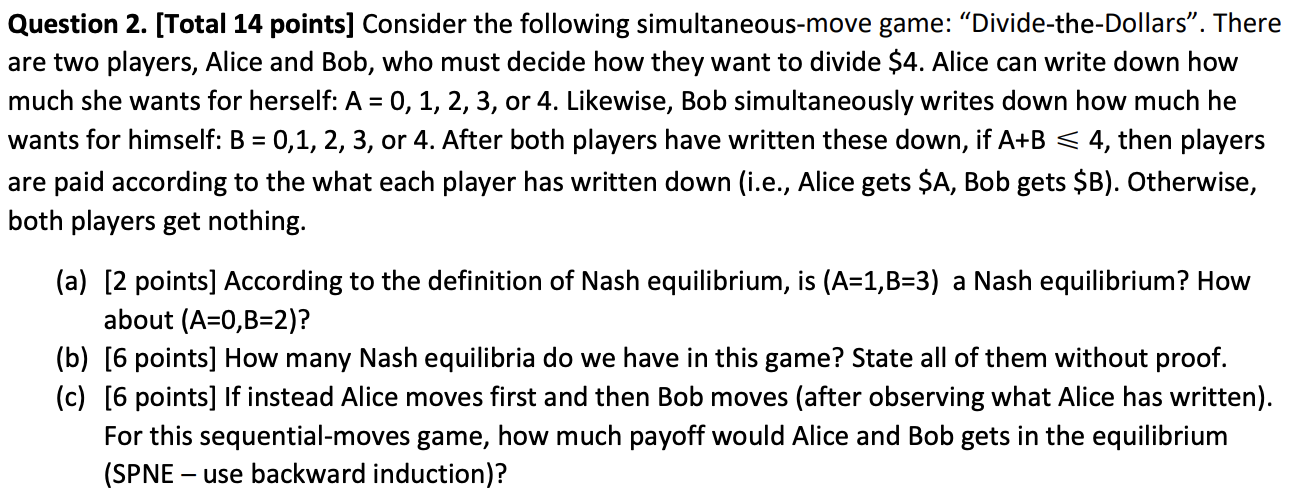
Question 2. [Total 14 points] Consider the following simultaneous-move game: "Divide-the-Dollars". There are two players, Alice and Bob, who must decide how they want to divide $4. Alice can write down how much she wants for herself: A = 0, 1, 2, 3, or 4. Likewise, Bob simultaneously writes down how much he wants for himself: B = 0,1, 2, 3, or 4. After both players have written these down, if A+B ≤ 4, then players are paid according to the what each player has written down (i.e., Alice gets $A, Bob gets $B). Otherwise, both players get nothing. (a) [2 points] According to the definition of Nash equilibrium, is (A=1,B=3) a Nash equilibrium? How about (A=0,B=2)? (b) [6 points] How many Nash equilibria do we have in this game? State all of them without proof. (c) [6 points] If instead Alice moves first and then Bob moves (after observing what Alice has written). For this sequential-moves game, how much payoff would Alice and Bob gets in the equilibrium (SPNE - use backward induction)?