Page 1 of 1
(7.4) For several decades, central banks in advanced economies typically used a (policy) interest rate as their tool for
Posted: Thu May 05, 2022 6:18 am
by answerhappygod
- 7 4 For Several Decades Central Banks In Advanced Economies Typically Used A Policy Interest Rate As Their Tool For 1 (109.17 KiB) Viewed 41 times
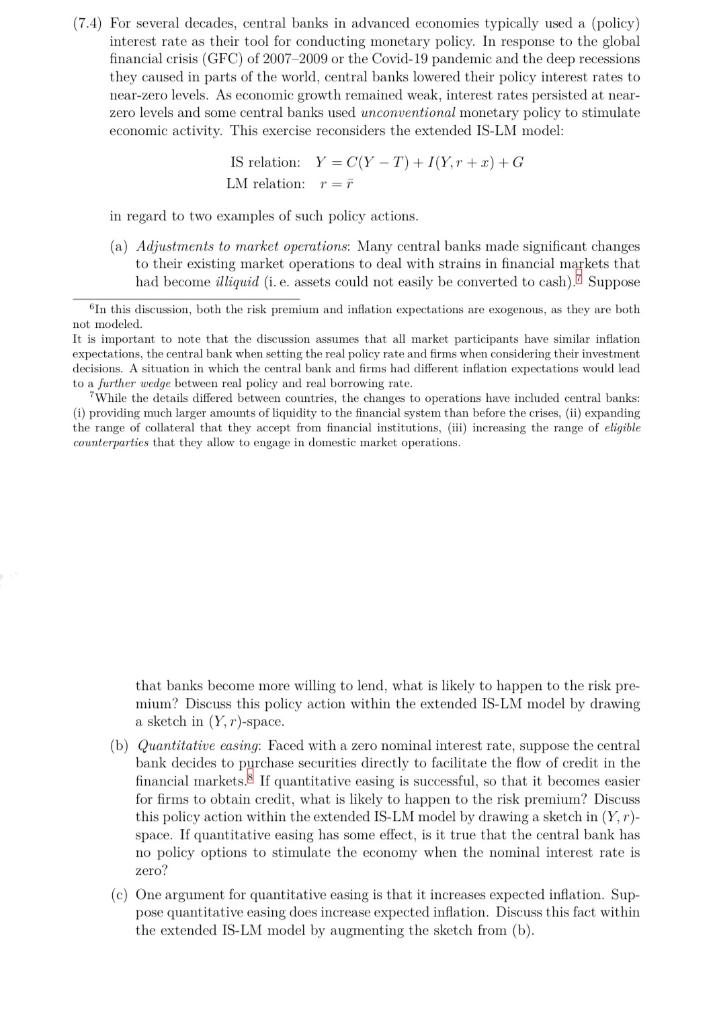
(7.4) For several decades, central banks in advanced economies typically used a (policy) interest rate as their tool for conducting monetary policy. In response to the global financial crisis (GFC) of 2007-2009 or the Covid-19 pandemic and the deep recessions they caused in parts of the world, central banks lowered their policy interest rates to near-zero levels. As economic growth remained weak, interest rates persisted at near- zero levels and some central banks used unconventional monetary policy to stimulate economic activity. This exercise reconsiders the extended IS-LM model: IS relation: Y = C(Y-T) + I(Yr+x) + G. LM relation: r=r in regard to two examples of such policy actions. (a) Adjustments to market operations: Many central banks made significant changes to their existing market operations to deal with strains in financial markets that had become illiquid (i. e. assets could not easily be converted to cash). Suppose In this discussion, both the risk premium and inflation expectations are exogenous, as they are both not modeled. It is important to note that the discussion assumes that all market participants have similar inflation expectations, the central bank when setting the real policy rate and firms when considering their investment decisions. A situation in which the central bank and firms had different inflation expectations would lead to a further wedge between real policy and real borrowing rate. "While the details differed between countries, the changes to operations have included central banks: (i) providing much larger amounts of liquidity to the financial system than before the crises, (ii) expanding the range of collateral that they accept from financial institutions, (iii) increasing the range of eligible counterparties that they allow to engage in domestic market operations. that banks become more willing to lend, what is likely to happen to the risk pre- mium? Discuss this policy action within the extended IS-LM model by drawing a sketch in (Y,r)-space. (b) Quantitative easing: Faced with a zero nominal interest rate, suppose the central bank decides to purchase securities directly to facilitate the flow of credit in the financial markets. If quantitative easing is successful, so that it becomes easier for firms to obtain credit, what is likely to happen to the risk premium? Discuss this policy action within the extended IS-LM model by drawing a sketch in (Y, r)- space. If quantitative easing has some effect, is it true that the central bank has no policy options to stimulate the economy when the nominal interest rate is zero? (c) One argument for quantitative easing is that it increases expected inflation. Sup- pose quantitative easing does increase expected inflation. Discuss this fact within the extended IS-LM model by augmenting the sketch from (b).