Page 1 of 1
Problem 2: As we discussed in class, quantum-well electroabsorption modulators rely on the Stark shift of the conduction
Posted: Wed May 04, 2022 1:55 pm
by answerhappygod
- Problem 2 As We Discussed In Class Quantum Well Electroabsorption Modulators Rely On The Stark Shift Of The Conduction 1 (147.77 KiB) Viewed 50 times
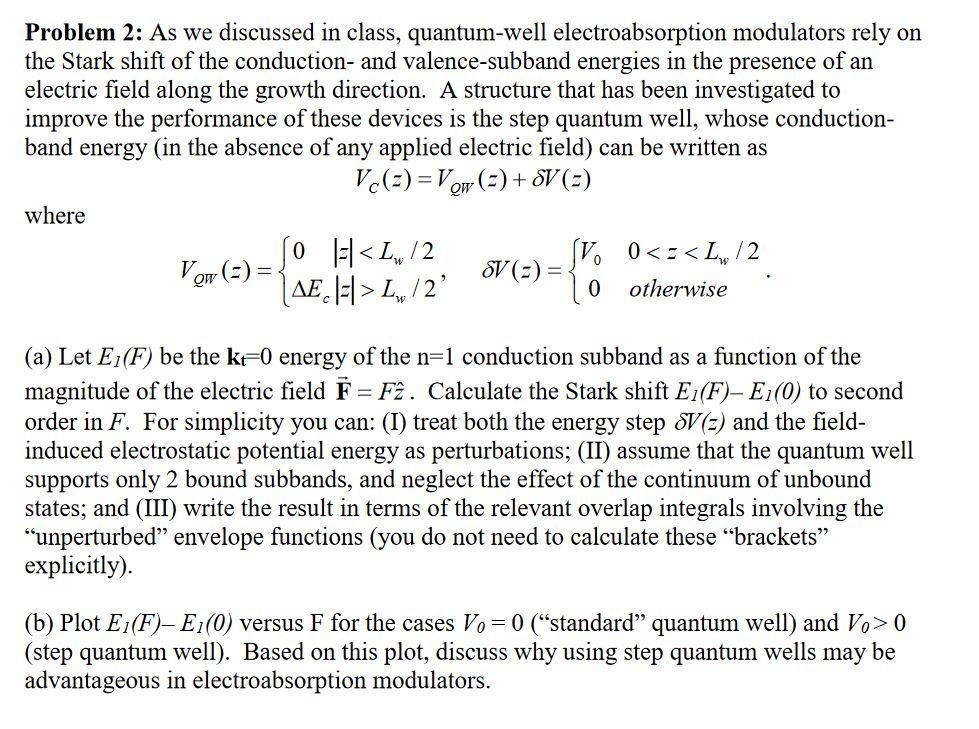
Problem 2: As we discussed in class, quantum-well electroabsorption modulators rely on the Stark shift of the conduction- and valence-subband energies in the presence of an electric field along the growth direction. A structure that has been investigated to improve the performance of these devices is the step quantum well, whose conduction- band energy (in the absence of any applied electric field) can be written as Vc() = Vow (3) + SV (5) where ſo II<L»/2 IV. 0<=<L./2 Vow (3) = SV(-) = AE. I-I>L,/2' otherwise w 0 0 = (a) Let E (F) be the k=0 energy of the n=1 conduction subband as a function of the magnitude of the electric field F = F2. Calculate the Stark shift Ei(F)- E1(0) to second order in F. For simplicity you can: (I) treat both the energy step 8V () and the field- induced electrostatic potential energy as perturbations; (II) assume that the quantum well supports only 2 bound subbands, and neglect the effect of the continuum of unbound states; and (III) write the result in terms of the relevant overlap integrals involving the "unperturbed” envelope functions (you do not need to calculate these "brackets" explicitly). (b) Plot Ei(F)- E10) versus F for the cases Vo = 0 (standard” quantum well) and Vo> 0 (step quantum well). Based on this plot, discuss why using step quantum wells may be advantageous in electroabsorption modulators.