Page 1 of 1
6. Considering Atomic Clocks. Atomic clocks are extremely accurate clocks: the first ones lost no more than 100 ns/day,
Posted: Wed May 04, 2022 1:46 pm
by answerhappygod
- 6 Considering Atomic Clocks Atomic Clocks Are Extremely Accurate Clocks The First Ones Lost No More Than 100 Ns Day 1 (247.04 KiB) Viewed 48 times
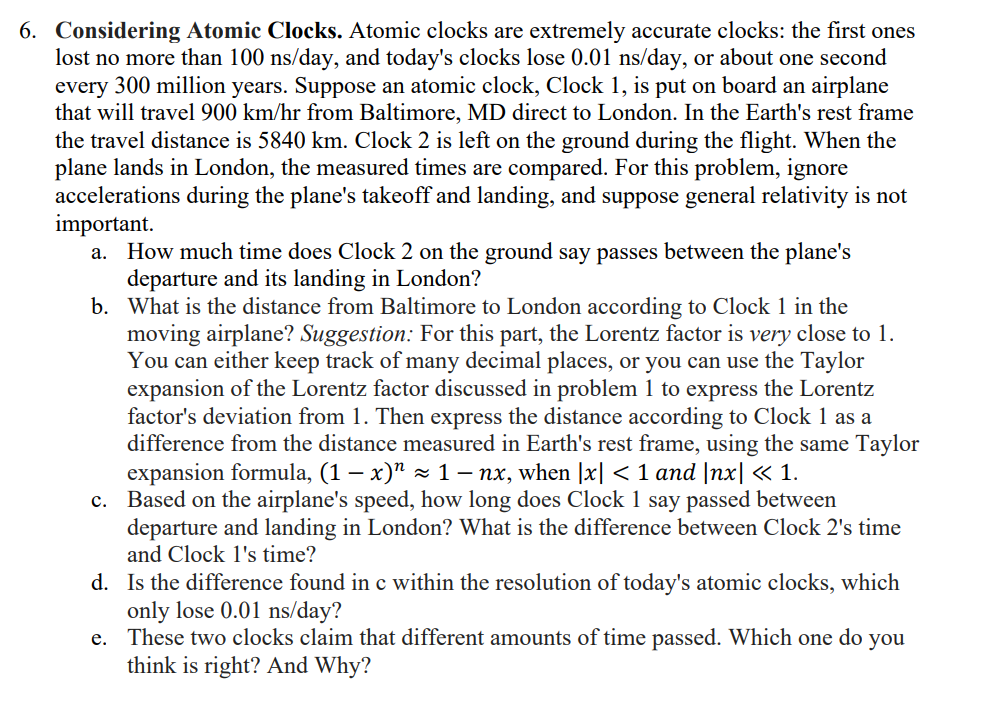
6. Considering Atomic Clocks. Atomic clocks are extremely accurate clocks: the first ones lost no more than 100 ns/day, and today's clocks lose 0.01 ns/day, or about one second every 300 million years. Suppose an atomic clock, Clock 1, is put on board an airplane that will travel 900 km/hr from Baltimore, MD direct to London. In the Earth's rest frame the travel distance is 5840 km. Clock 2 is left on the ground during the flight. When the plane lands in London, the measured times are compared. For this problem, ignore accelerations during the plane's takeoff and landing, and suppose general relativity is not important. a. How much time does Clock 2 on the ground say passes between the plane's departure and its landing in London? b. What is the distance from Baltimore to London according to Clock 1 in the moving airplane? Suggestion: For this part, the Lorentz factor is very close to 1. You can either keep track of many decimal places, or you can use the Taylor expansion of the Lorentz factor discussed in problem 1 to express the Lorentz factor's deviation from 1. Then express the distance according to Clock 1 as a difference from the distance measured in Earth's rest frame, using the same Taylor expansion formula, (1 − x)" ≈ 1- nx, when |x| < 1 and |nx| « 1. c. Based on the airplane's speed, how long does Clock 1 say passed between departure and landing in London? What is the difference between Clock 2's time and Clock 1's time? d. Is the difference found in c within the resolution of today's atomic clocks, which only lose 0.01 ns/day? e. These two clocks claim that different amounts of time passed. Which one do you think is right? And Why?