Page 1 of 1
6. Griffiths describes traveling waves in rectangular waveguides. But, if you enclose the waves in a metal box that is a
Posted: Wed May 04, 2022 1:35 pm
by answerhappygod
- 6 Griffiths Describes Traveling Waves In Rectangular Waveguides But If You Enclose The Waves In A Metal Box That Is A 1 (55.73 KiB) Viewed 42 times
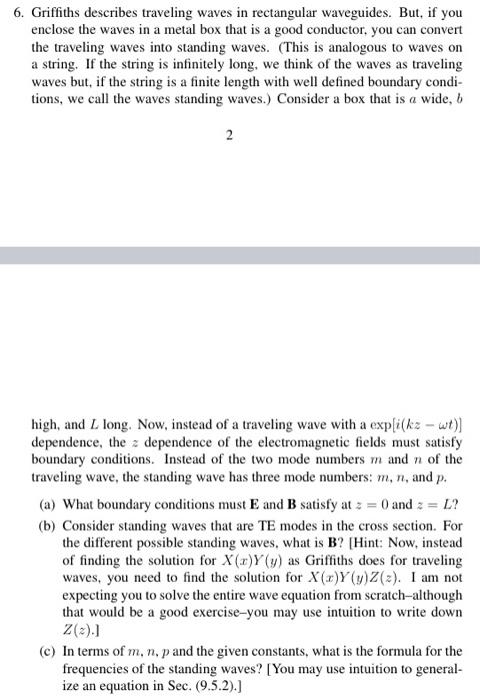
6. Griffiths describes traveling waves in rectangular waveguides. But, if you enclose the waves in a metal box that is a good conductor, you can convert the traveling waves into standing waves. (This is analogous to waves on a string. If the string is infinitely long, we think of the waves as traveling waves but, if the string is a finite length with well defined boundary condi- tions, we call the waves standing waves.) Consider a box that is a wide, b 2 high, and L long. Now, instead of a traveling wave with a expli(kz - wt)] dependence, the dependence of the electromagnetic fields must satisfy boundary conditions. Instead of the two mode numbers m and n of the traveling wave, the standing wave has three mode numbers: m, n, and p. (a) What boundary conditions must E and B satisfy at z = 0 and 2 = L? (b) Consider standing waves that are TE modes in the cross section. For the different possible standing waves, what is B? [Hint: Now, instead of finding the solution for X(x)Y(y) as Griffiths does for traveling waves, you need to find the solution for X(z)Y(y)Z(z). I am not expecting you to solve the entire wave equation from scratch-although that would be a good exercise-you may use intuition to write down Z(z).] (c) In terms of m, n, p and the given constants, what is the formula for the frequencies of the standing waves? [You may use intuition to general- ize an equation in Sec. (9.5.2).]