- Learning Goal To Apply The Principle Of Angular Impulse And Momentum To Describe A Particle S Motion The Moment Of A F 1 (43.96 KiB) Viewed 60 times
- Learning Goal To Apply The Principle Of Angular Impulse And Momentum To Describe A Particle S Motion The Moment Of A F 2 (41.11 KiB) Viewed 60 times
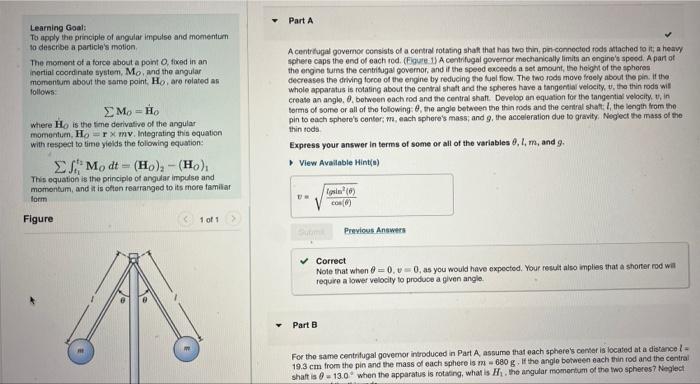
Learning Goal: To apply the principle of angular impulse and momentum to describe a particle's motion, The moment of a force about a point O, fixed in an inertial coordinate system, Mo, and the angular momentum about the same point, Ho, are related as follows: ΣMo - Ho where Ho is the time derivative of the angular momentum, Horx mv. Integrating this equation with respect to time yields the following equation: Σ Mo dt- (Ho), - (Ho), This equation is the principle of angular impulse and momentum, and it is often rearranged to its more familiar. form Figure 1 of 1 Y Part A A centrifugal governor consists of a central rotating shaft that has two thin, pin-connected rods attached to it; a heavy sphere caps the end of each rod. (Figure 1) A centrifugal governor mechanically limits an engine's speed. A part of the engine turns the centrifugal governor, and if the speed exceeds a set amount, the height of the spheres decreases the driving force of the engine by reducing the fuel flow. The two rods move freely about the pin. If the whole apparatus is rotating about the central shaft and the spheres have a tangential velocity, u, the thin rods will create an angle, 0, between each rod and the central shaft. Develop an equation for the tangential velocity, in terms of some or all of the following: 0, the angle between the thin rods and the central shaft, I, the length from the pin to each sphere's conter; m, each sphere's mass; and g, the acceleration due to gravity. Neglect the mass of the thin rods Express your answer in terms of some or all of the variables 0, 1, m, and g. ▸ View Available Hint(s) UN Igsin (0) cos(6) Previous Answers ✓ Correct Note that when=0.0, as you would have expected. Your result also implies that a shorter rod will require a lower velocity to produce a given angle. Part B For the same centrifugal govemor introduced in Part A, assume that each sphere's center is located at a distance I- 19.3 cm from the pin and the mass of each sphere is m 680 g. If the angle between each thin rod and the central shaft is -13.0" when the apparatus is rotating, what is H₁, the angular momentum of the two spheres? Neglect
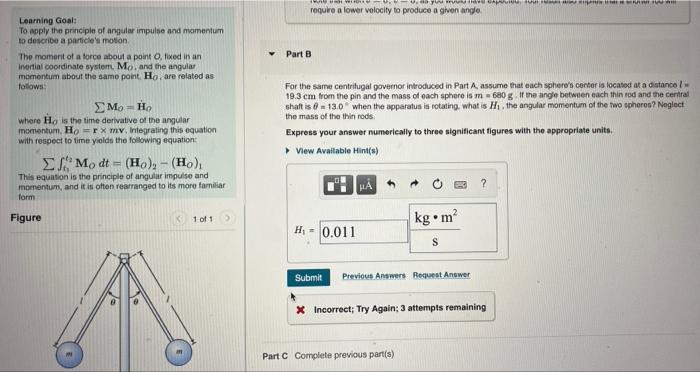
Learning Goal: To apply the principle of angular impulse and momentum to describe a particle's motion. The moment of a force about a point O, fixed in an i inertial coordinate system. Mo, and the angular momentum about the same point, Ho, are related as follows: ΣΜo Ho where Ho is the time derivative of the angular momentum, Horx mv. Integrating this equation with respect to time yields the following equation: Σ Mo dt = (Ho)₂-(Ho), This equation is the principle of angular impulse and momentum, and it is often rearranged to its more familiar form Figure 1 of 1 you most what we require a lower velocity to produce a given angle. Part B For the same centrifugal governor introduced in Part A, assume that each sphere's center is located at a distance I 19.3 cm from the pin and the mass of each sphere is m=680 g. If the angle between each thin rod and the central shaft is 13.0" when the apparatus is rotating, what is H₁, the angular momentum of the two spheres? Neglect the mass of the thin rods. Express your answer numerically to three significant figures with the appropriate units. ▸ View Available Hint(s) HA ? kg m² . H₁ = 0.011 S Submit Previous Answers Request Answer * Incorrect; Try Again; 3 attempts remaining Part C Complete previous part(s)