Page 1 of 1
Betsy and Bert are inertial observers moving in the x-direction. Bert is moving to the right in Betsy's frame at speed 3
Posted: Wed May 04, 2022 1:34 pm
by answerhappygod
- Betsy And Bert Are Inertial Observers Moving In The X Direction Bert Is Moving To The Right In Betsy S Frame At Speed 3 1 (106.68 KiB) Viewed 47 times
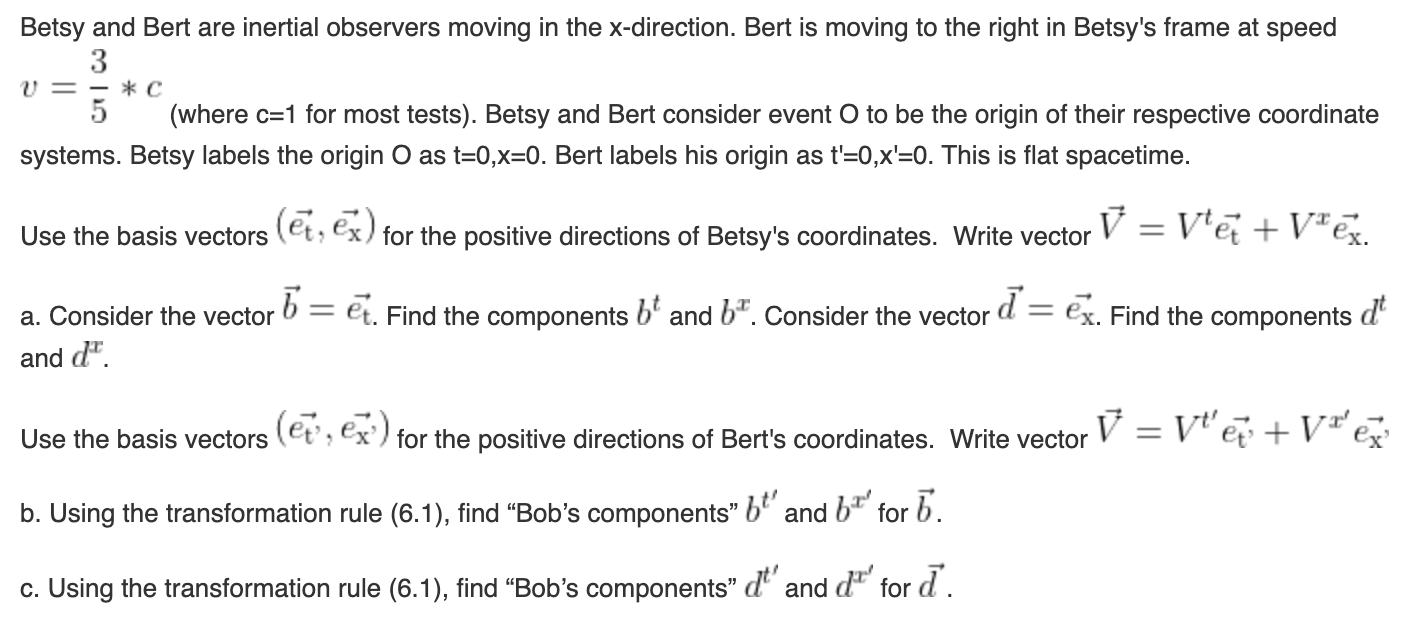
Betsy and Bert are inertial observers moving in the x-direction. Bert is moving to the right in Betsy's frame at speed 3 V = *C 5 (where c=1 for most tests). Betsy and Bert consider event O to be the origin of their respective coordinate systems. Betsy labels the origin O as t=0,x=0. Bert labels his origin as t'=0,x'=0. This is flat spacetime. Use the basis vectors (et, ex) for the positive directions of Betsy's coordinates. Write vector V = V¹ + V¹ ex. 6 et. Find the components bt and br. Consider the vector d = ex. Find the components d a. Consider the vector = and dt. Use the basis vectors (e, ex) for the positive directions of Bert's coordinates. Write vector V = V¹ + V¹¹ ex b. Using the transformation rule (6.1), find “Bob's components" b' and b for b. c. Using the transformation rule (6.1), find "Bob's components" d' and d' for d.
Introduction. We have seen that a (four-)vector is defined to be a quantity whose com- ponents transform in a specific way (i.e., like the components dx" of the displacement vector ds) when we change our coordinate system: Əx' A'H= -AV Əəx" (6.1) In this section, we will see how this definition fits into a larger scheme of quantities called tensors, and we will finally discover the fundamental reason why some compo- nent labels are written as superscripts and others as subscripts.