Page 1 of 1
2. Bronchoconstriction in asthmatic airways or normal airways exposed to bronchoconstrictive agents may result in smooth
Posted: Wed May 04, 2022 1:31 pm
by answerhappygod
- 2 Bronchoconstriction In Asthmatic Airways Or Normal Airways Exposed To Bronchoconstrictive Agents May Result In Smooth 1 (835.47 KiB) Viewed 48 times
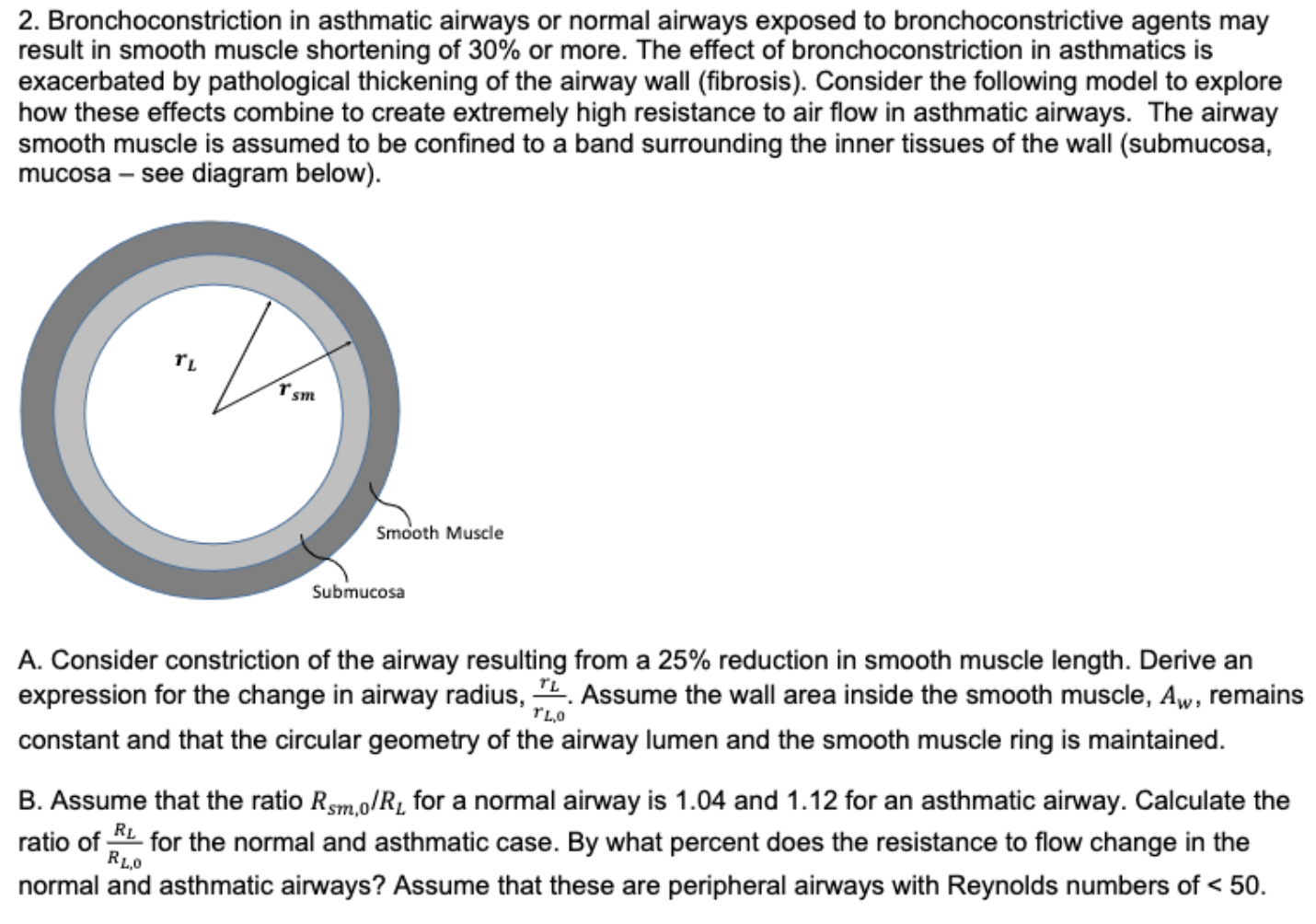
2. Bronchoconstriction in asthmatic airways or normal airways exposed to bronchoconstrictive agents may result in smooth muscle shortening of 30% or more. The effect of bronchoconstriction in asthmatics is exacerbated by pathological thickening of the airway wall (fibrosis). Consider the following model to explore how these effects combine to create extremely high resistance to air flow in asthmatic airways. The airway smooth muscle is assumed to be confined to a band surrounding the inner tissues of the wall (submucosa, mucosa - see diagram below). TL Tsm Smooth Muscle Submucosa TL TL,0 A. Consider constriction of the airway resulting from a 25% reduction in smooth muscle length. Derive an expression for the change in airway radius, Assume the wall area inside the smooth muscle, Aw, remains constant and that the circular geometry of the airway lumen and the smooth muscle ring is maintained. B. Assume that the ratio Rsm,o/R₂ for a normal airway is 1.04 and 1.12 for an asthmatic airway. Calculate the ratio of for the normal and asthmatic case. By what percent does the resistance to flow change in the RL,0 normal and asthmatic airways? Assume that these are peripheral airways with Reynolds numbers of < 50.